
Food Waste is Best Defined as a Feedstock – Food Price Fun
June 24, 2026 was National Upcycling Day, in the month of June that was Food Upcycle Month. On social media that day, I saw a comment by a food waste group that “food waste is a feedstock.” In food waste circles, vilifying food by overstating cost to the US economy, has become popular.
Food waste is a feedstock. It should be used, not isolated by building a negative culture.
When the focus is on the leakage and external costs of any byproduct, the best you can do is lower the costs. By defining underutilized byproducts as a feedstock, reuse is anticipated. The expectation is reuse. This idea is reenforced in the two very different ways manure is isolated in the language of the Clean Water Act (CWA) and innovative solutions are facilitated in the language of the Clean Air Act (CAA). Other recent Biomass Rules blog posts on the circular bioeconomy and labels used to bind externalities outside the economy, rather than pull them back into the economy.
Reusing organic leftovers is far easier than reusing many other inorganic residuals. To do so requires planners to move beyond the ‘yuck’ factor. Regulations that define the negative components of a regulated material are important for human hygiene and safety. They keep us all alive. Rules that point regulated materials to reuse, only work if the innovative solution honors the original safety concerns. It is not simply a relabeling exercise. However, relabeling is part of the success.
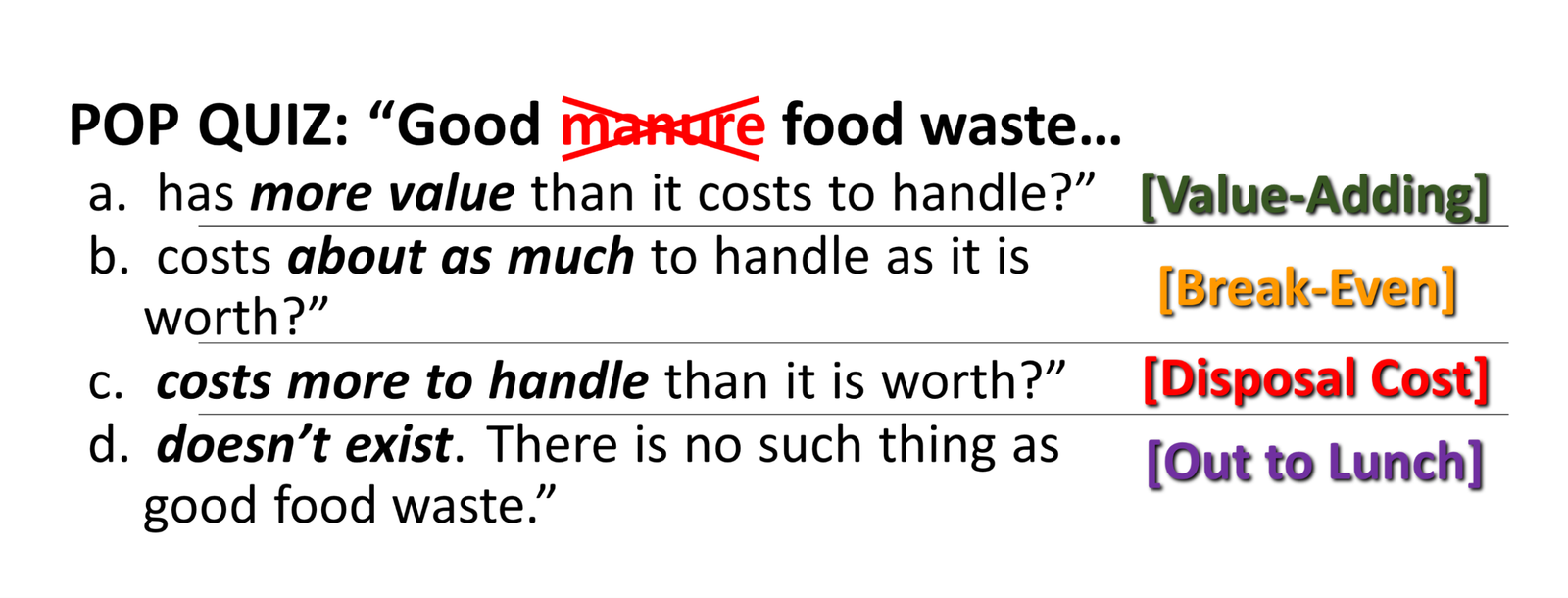
The graphic in this post is a recycled graphic from my favorite manure paper title, “MAN-U-Re Good!” It was originally written about 25 years ago in the throes of the policy battles of the CAFO Rule revision era (1998 – 2008). The collision of the facts with the enormity of the political battle had everyone spinning individual plates and none of them connected with each other or with basic economic principles. In the case of manure, there are 1) costly economic liabilities, 2) break even costs, and 3) opportunities to add value and generate revenue. There is a 4th category that contains the largest number of voices, which are those individuals (self-certified experts) who are merely spreading bits of truth that they choose not to understand.
Food waste as a feedstock works the same. The only real difference is that the US is really good at finding new uses for food waste. One of my favorite food waste reuse successes is the livestock feed ingredient, ‘meat and bone meal.’ This is processed slop from meat processing. Meat and bonemeal, the feed ingredient, is no longer slop. It has a label that defines meat and bone meal (either porcine or ruminant) and it is free of pathogens. Last week according to USDA, Agricultural Marketing Service (AMS), it sells for around $300 per ton. Feathermeal sells for $400 per ton. Food wastes for decades have been providing feed ingredients for livestock feed, pet food, and energy production.
The most compelling food waste of value is whey protein. In the 2002 paper I wrote for the American Farm Bureau Federation, “Tasty Waste, …No Whey!”, it was already being used as an ingredient in human food. It has become even more valuable in 2026. In a June 20, 2026, Wall Street Journal Article, it was reported that there is a scarcity of whey protein concentrate 80, used now as a protein supplement. They reported a price of $13 per pound, which is $26,000 per ton. Not too bad for a material that was once disposed of in the sewers.
To be sure, whey sewage of the 1970s and 2026 whey protein concentrate are not the same thing! The whey byproduct feedstock is similar of course. But 50 years ago, the technology did not exist to extract the most valuable form of the whey protein. The technology did not exist to package the whey protein in the form it is being sold today. And most importantly, it has taken 50 years and many new whey protein product launches to build a demand for the 2026 whey protein products.
It did not happen by focusing only on the fact that whey waste had a disposal cost in the 1970s. In other words, the supply of whey protein in the 1970s overwhelmed the demand for whey protein and so it was disposed of at a cost into available sewers to be treated with other wastewater (as an externality).
Similarly, restaurants contract with cooking oil collectors to pick up their regulated food wastes. The costs are greater than the direct benefit of waste vegetable oil to the restaurants. These restaurant costs are economic externalities. Fryer oil is too complex to simply send to the sewers. With the advent of (technology and markets) for renewable diesel fuel, opportunities have been created to import used cooking oil to use in biofuel to meet the market demand (Local supply was not sufficient). In March, a chart was circulated that showed in California renewable diesel fuel volumes are larger than fossil diesel fuel volumes. Food waste is beginning to power the US. This opportunity is driving excitement about renewable natural gas (RNG), specifically from food waste.
We cannot power the US on food waste. Although the Wall Street Journal did suggest that whey protein prices may become the new price point in cheese manufacturing. The cheese plants would then become whey protein factories with a byproduct of cheese. Food for thought.
Food waste is a giant complex challenge. It is not a zero-sum game. We always need to hedge on having a surplus of food rather than having a shortage of food. Front loading food security as a national goal means there will be some food that if unused. This is a lower cost than having an authentic food shortage, or less available food than expected.
There are multiple labels with differing health standard interpretations. It is not an easy nut to crack. But brilliant people and companies are working on it. Food waste is a container of resources that must be better managed. But what is actually in that container rotates in and out as better information and technologies develop.
There is no long-term benefit to defining food waste as an economic externality. Stop it. Food waste that is reused is no longer food waste. To lower food waste as a liability and as an additional cost, it must be ultimately defined as a feedstock.
Comments
Food Waste is Best Defined as a Feedstock – Food Price Fun — No Comments
HTML tags allowed in your comment: <a href="" title=""> <abbr title=""> <acronym title=""> <b> <blockquote cite=""> <cite> <code> <del datetime=""> <em> <i> <q cite=""> <s> <strike> <strong>