
Remember, US Farms Continually Produce more Outputs using Fewer Inputs!
The last several years, identifying challenges with the US food system has become a popular sport. Food prices are rising and public conversations of food waste are growing. This may cast doubt about the US food system. The US food system has been, and continues to be, a profound success story!
Innovators at Biomass Rules have spent 50 years working to make food systems the most efficient. I have skin in the farm efficiency game. The US food system is working remarkably well. We still need to work toward lower food prices and reduce our food waste. We can never afford to be complacent. But the system is very efficient.
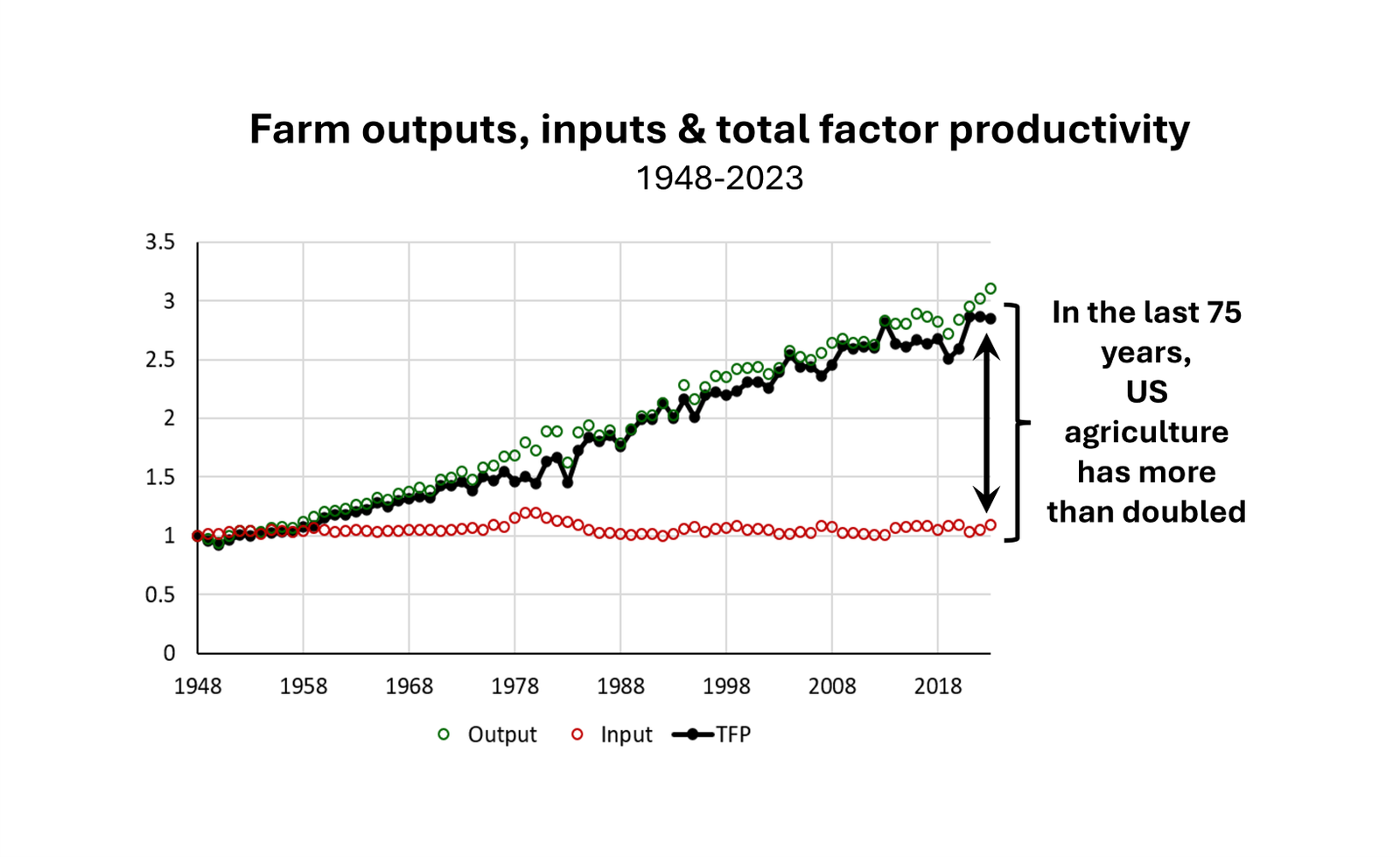
This is a foundation of USDA, Economic Research Service (ERS) agricultural analyses. It shows US agricultural total factor productivity (TFP). The USDA, ERS defines TFP as:
Total Factor Productivity (TFP) growth is the difference between growth of total output and growth of total inputs used. Total output comprises the aggregate of farm production including crops, meat and dairy products, whereas total inputs comprise land, labor, physical capital, and intermediate inputs such as fertilizers and pesticides. Therefore, TFP, measures changes in the efficiency with which inputs are transformed into outputs.
For 75 years, when inputs are held constant, the TFP of US farm production has risen 1.4 percent on average annually. Each individual year, the TFP rises and falls. But through wars and global conflicts and economic shocks like pandemics, trade wars, and recessions; total US farm production efficiency and TFP have risen steadily.
The US government subsidizes US farmers. It is a safety net that lowers food prices for the nation providing security to all. The farm programs provide an abundant supply of wholesome commodities at low prices that keep retail food prices lower. Even within the farm bill payments, farmers only receive about 20 percent of the federal dollars that are paid from the farm bill, some of those farmer-available funds also provide for conservation and natural resources.
Food waste can be a challenge. It could be reduced much more, and it will be. When public attention points to leakage in the agricultural production systems, multiple players find cost-effective ways to pull the byproduct that is in the current news, back into the economy. Food waste currently provides feed ingredient for livestock and pets. This works well because the best technology and science are used to meet safety and nutrition standards that are set and monitored. Occasionally, the standards are revisited and modified as we learn more collectively.
Food waste is a label container for unwanted byproducts. Every time new uses and higher values are discovered for byproducts, the materials located in the food waste container cycle out and new byproducts enter into the container. There is always a container of food waste, but the specific contents inside that container are always shifting.
Dry whey protein, recently in the Wall Street Journal for being in short supply as a human food ingredient, was once housed in the food waste container. Currently the byproduct of cheese production, whey protein, is influencing cheese production decisions. Byproducts operate at the production level of the principle production output (like cheese).
US farms and food producers are leaders when it comes to continually delivering more output with fewer inputs. Part of this is due to technology and part also due to policies. But a significant factor in increasing Total Factor Productivity in farms is our ability to pull byproducts back into the economy in ways the lower waste output and convert those resources into value-adding resources. The recycling of these farm byproducts back into new uses lower production costs. This is an aspect of the US farm and food system that Biomass Rules knows very well.
Food prices and food waste demand attention, but do not dismiss the best of the US farm and food production systems. This USDA, ERS TFP dataset is based on 75 years of historical data, looking back. It is not a forecast into the future. US farmers and their support industries are very efficient at producing more with less. That is the definition of efficiency. Do not simply complain about US farms a brilliant US industry, simply because it is easy to do so.
Pingback:US Dairy Farms Keep Lowering Methane Emissions – Biomass Rules