
Self-Reliance and Compost Therapy on Independence Day – Biomass Rules!
While a Peace Corps Volunteer in Nepal, 40 years ago, I could tell the time on a cloudless night by the rotation of the stars around the North Star. That was a pretty cool revelation. Biomass Rules posts a lot of personal compost pile pictures, but we are not quite to the point of telling the season of the year by the stage of the compost pile.
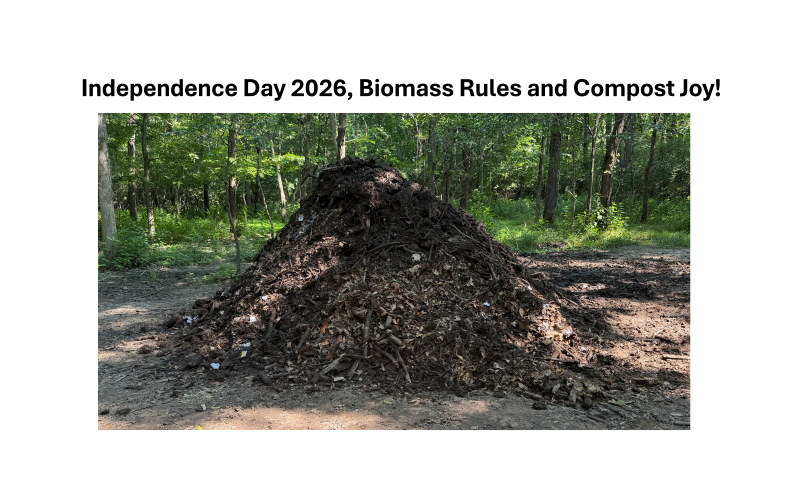
Biomass Rules aspires to self-reliance, but only when it makes economic sense. Over the course of my career, the backyard compost pile has increased in size. While working in agricultural policy in Chicagoland 3o years ago, turning the compost pile the size of a small car, by hand with my 3-point shovel, was calming therapy for me. In 2026, I have a small tractor with a loader, so my compost pile is larger. Plus there are more invasive species, food waste, junk mail, cardboard packaging, and worn out cotton fabric.
We are not off-the-grid, but we send about 5 gallons of trash to the landfill each week. I always wonder if the trash truck driver enjoys dumping our 5-gallon trash bag out of our 90-gallon trashcan each week. We pay the same rate as our neighbor that cannot shut the over-flowing lid on their 90-gallon can, but it is the principle of it all. I am making choice for me, not for my neighbor.
This year arrived with multiple unexpected distractions and my compost operation is about 2 months behind my plan. I tear the paper and cardboard into 1 or 2 inch pieces first. There is a lot of prep time, but I call it therapy. The way one accounts for the time spent is what makes the balance sheet work. I spread 5-6 cubic yards of stable compost on our yard earlier this year, …with a shovel. It was slow. But my peers spend similar amounts of their time working out at a gym. Not only investing time in their discipline, but also a membership fee to use the facilities.
Some of what I meditate on as I work my hand-harvested invasive species and food scraps into my organic soil amendment is the value of learning to do things by hand. Whether it is
- building bioenergy operating on surplus organic byproducts,
- building first-of-their kind production system spreadsheet models,
- repurposing worn out cotton clothing into quilts, or
- spreading a mountain of compost with a shovel;
There are things that one learns doing it manually. Watching the operations transform, noting the pinch-points, and material flows to get from start to finish. This is time consuming, but significantly informative.
Ramping up to automated systems once the process is fully understood saves on the more costly trial-and-error from learning while purchasing capital.
Preparing lesson plans that allowed students to ‘learn by doing’ was always the teaching target for the entire 8 years in which I taught. There is value in learning that somethings work while others do not work. We all launch and recover at different rates. Leading a class of students through a process together was a challenge to orchestrate successfully. But completely worth it, when it worked.
The Greenville University agribusiness students were a small part of the student population I taught in their business school. I asked more from the agribusiness students than I did of the general business students. Most of the agribusiness graduates learned to leap with me into unknown frontiers, because they learned over their 4 years with me that they were going to see things that were not always obvious at the start. That was one of my favorite trophies from my teaching career.
July 4, 2026 is the 250th anniversary of our nation. Fifty years ago, 1976, was the year I graduated from high school. Within the first ten years of that date, I had worked on farms in the US, Germany, and Nepal. In 1985, I launched my own farrow-to-feeder pig farm. Time is our friend. I proudly served 2 years of public service in the Peace Corps, because I had choices that my ancestors did not have. I also proudly stand on the shoulders of my military brothers and sisters how have made it possible for me to have choices to make. I have worked alongside citizens from many nations and I choose to live in the United States even when surrounded by economic uncertainty.
It is a good day to celebrate independence from being a colony, as well as celebrating independence from reliance on our economic infrastructure services, and dependence on simply carrying forward the knowledge we inherited from earlier generations. We can always do better. I am inspired by brilliant young professionals who are the rising stars that I follow each day and watch shape tomorrow. It is a good day to celebrate!
Happy Independence Day in the United States, 2026! Be safe!
Comments
Self-Reliance and Compost Therapy on Independence Day – Biomass Rules! — No Comments
HTML tags allowed in your comment: <a href="" title=""> <abbr title=""> <acronym title=""> <b> <blockquote cite=""> <cite> <code> <del datetime=""> <em> <i> <q cite=""> <s> <strike> <strong>