
Regulating Carbon Emissions into Water and Air – Old School Style
Manure is not created equally. Livestock feces and urine is composed of unused carbohydrates, nutrients, and water, and it is not homogeneous.
Corn, soybeans, and forages go into livestock and poultry feed, but what comes out depends on environmental conditions, genetics, species of animal, and stage of growth. What comes out is a direct function of what goes in, so monogastric manure differs from ruminant manure. Culturally, there is a significant lag behind the science and the regulatory oversight. It was not until about 20 years ago that the ASAE manure composition data was updated from the 1970s. Millions of dollars were spent on negotiating the Clean Water Act, Concentrated Animal Feeding Operation (CAFO) rules in the first decade of the new century, based on data from less than 100 animals by species that were tested in the 1970s (eating who knows what).
But manure regulations are also not created equally, or uniformly. This post compares the language for the definition of manure in the Clean Water Act (CWA) regulations with the language in the Clean Air Act (CAA) regulations. Aligning the rules directed at environmental liabilities, externalities, and the rules that facilitate their reinternalization are part of moving wastes back into the economy. A coordinated policy infrastructure is part of creating a functional circular bioeconomy. The CWA and CAA are not generally considered carbon policies, but that is a political under sight. In addition to all the more recent carbon-centric fuel policies, Biomass Rules considers state and federal policies that impact any of the following to play a role in managing domestic carbon.
- All food and agriculture
- All water, solid waste, and air quality policies
- All tax policies
- All wildlife policies
- All forestry and forest products
- All energy policies
- All biomass utilization and marketing
- All national parks (What is the value of a recreational carbon footprint?)
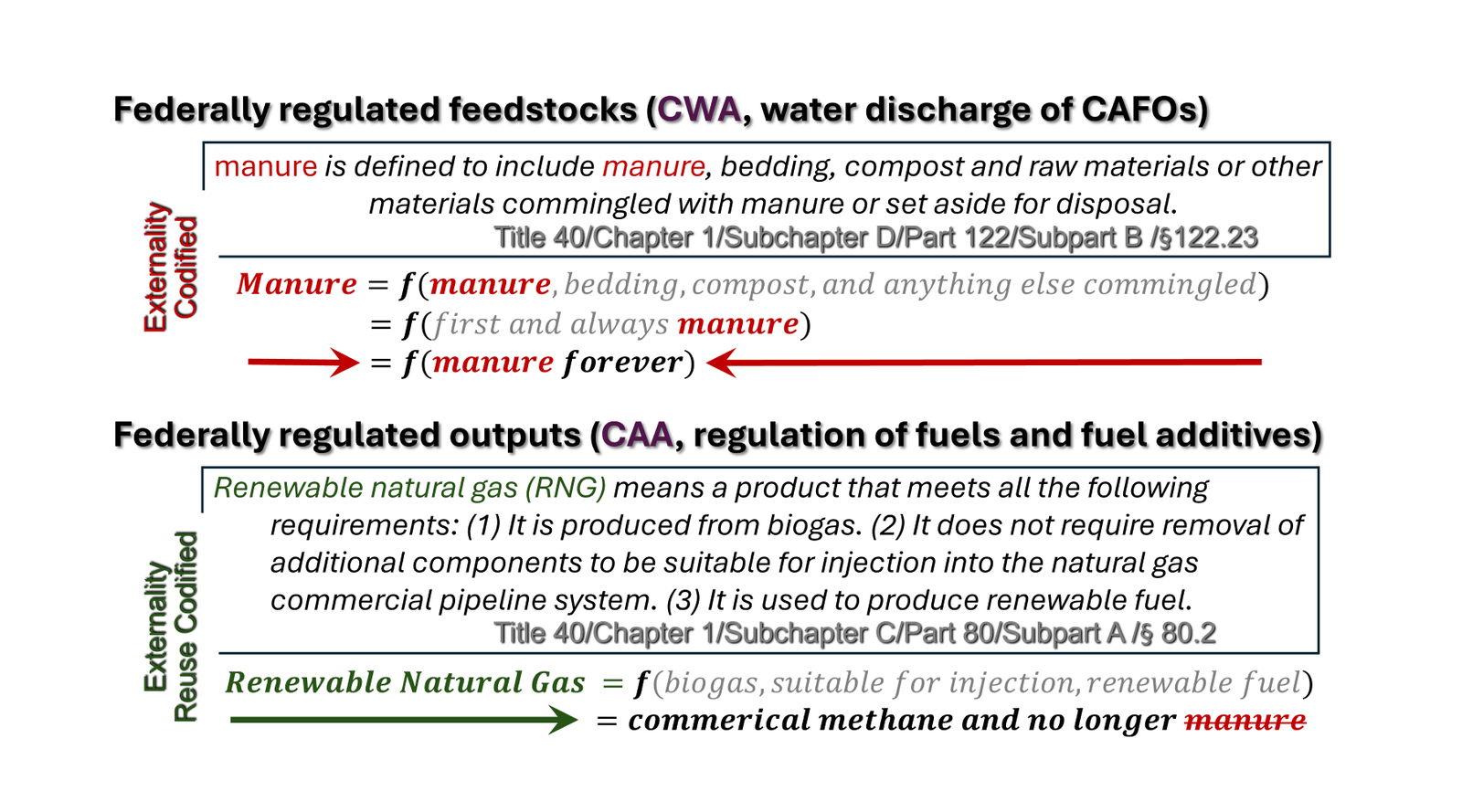
The production byproduct, manure which is a water quality threat from surplus carbohydrates, nutrients, and pathogens, is used to define manure in the CWA regulations. This definition of manure is focused on what goes into manure (inputs), rather than manure as a product or output. To avoid costly water quality tests, the CWA regulations often achieve compliance by meeting certain prescriptive practices (looking how the manure was produced). If the approved practice or technology is used then the rule will achieve its objective. This definition is not without value.
It would make more sense if the word ‘manure’ in the CWA definition was replaced with ‘feces and urine’. There is a cultural practice of referring to ‘feces and urine as excreted’ as equivalent to manure with bedding added like broiler litter, or anaerobic lagoon effluent. Both of these later forms are found on farms, but bedding and anaerobic digestion are treatments, and the resulting products are no longer chemically equivalent to the excreted feces and urine. The way the law is currently written, using the term being defined as a qualifier in the definition, is not logical.
The CAA definition here is for Renewable Natural Gas (RNG). Manure is not mentioned anywhere in the RNG definition. But manure is one of the primary feedstocks in making RNG today. Clearly, the CAA regulation here is focused on the output, not the feedstock or input.
The CAA, on the contrary, has traditionally focused on outcomes and products for compliance. Monitoring smokestacks and air emissions is very expensive. It also affirms success in the regulatory objective when the emission tests meet the numeric standards set in the regulations. In this RNG example, it is simply a definition, not a numeric standard. The RNG definition clearly focuses on the product, not the feedstock used to create the product.
There are multiple confounding compliance factors in administering the CAFO rule. One of them is that an average nutrient content of the organic waste byproduct on the site must be established. Obtaining consistent samples is not easy. For the manure producer, there is much variability in the nutrient content of the waste stream. It is convenient for the manure producer that the regulations call for an average value.
It becomes more difficult, however, if the manure producer is selling the waste manure. Every state has fertilizer laws that require a guaranteed analysis to sell nutrients. While working in Missouri, reviewing state fertilizer test reports was interesting. Every year, it is not uncommon for some fertilizer samples to fall below the test standards. These findings show that it is a valuable service that the state holds fertilizer vendors accountable. But it also underscores the challenge of mitigating the differences between and average nutrient content for the manure production rules and the guaranteed minimum analysis of state fertilizer nutrient laws.
It is noteworthy that the Clean Water Act (CWA) regulations are structured differently than the Clean Air Act (CAA) regulations. As discussed in the earlier post on pulling externalities back into the economy, the CAA rules are better for that than the CWA rules.
It also is compelling that the policies that cultivate RNG, actually incentivize the production of more methane gas (natural gas is 88 percent methane). Oxidizing, or burning, natural gas converts it to carbon dioxide and water. But there is concern that beef and dairy producers are adding to atmospheric methane levels. We know today that it isn’t methane in a container that is the concern. We are concerned about methane that is leaking into the atmosphere. As long as it is contained and managed, it is economic growth with limited atmospheric harm. RNG is made from atmospheric carbon. So, when carbon dioxide is released into the atmosphere from the combustion of methane, it is going back to where it originated. It does not come from ancient fossil carbon.
In summary, CWA rules solely focus on protecting the waters of the United States directing stakeholders to look at prescribed practices. The CAA rules focus on desired outcome standards, which work like markets. Standards that also have a market demand, like natural gas, allow materials that were once environmental externalities to become value-adding products and get pulled back into the economy. Pulling externalities back into the economy while adding value takes a regulatory infrastructure that allows it to happen.
Comments
Regulating Carbon Emissions into Water and Air – Old School Style — No Comments
HTML tags allowed in your comment: <a href="" title=""> <abbr title=""> <acronym title=""> <b> <blockquote cite=""> <cite> <code> <del datetime=""> <em> <i> <q cite=""> <s> <strike> <strong>