
Solutions to Economic Externalities Require Both Problem Definition and Vision
In the throes of providing leadership on contract poultry grower challenges in the late 1990s, a brilliant mentor, Larry Cole, PhD., challenged me on whether I wanted to be 1) part of the defining the problem or 2) part of developing a solution. He said they are both very important, but it is very difficult for problem solvers to lead to effective solutions. It was a cusp of understanding as a young professional that has stayed with me for the last 35 years.
I took the job I had back then, an economist for the American Farm Bureau Federation, because I had three graduate degrees in manure management. Manure in the US in the late 1990s was a significant economic externality. So much so that the US EPA, who already had regulatory oversite of farm manure producers through the Clean Water Act was doubling down on manure utilization. But there are many moving parts in the farm economy. I had responsibilities for poultry grower contracts and also USDA oversight of fish farmers. Economic externalities, whether it is manure in the waters of the US, lack of transparency in production contracts, or insufficient access to USDA programs, all have similar problem definition and resolution requirements.
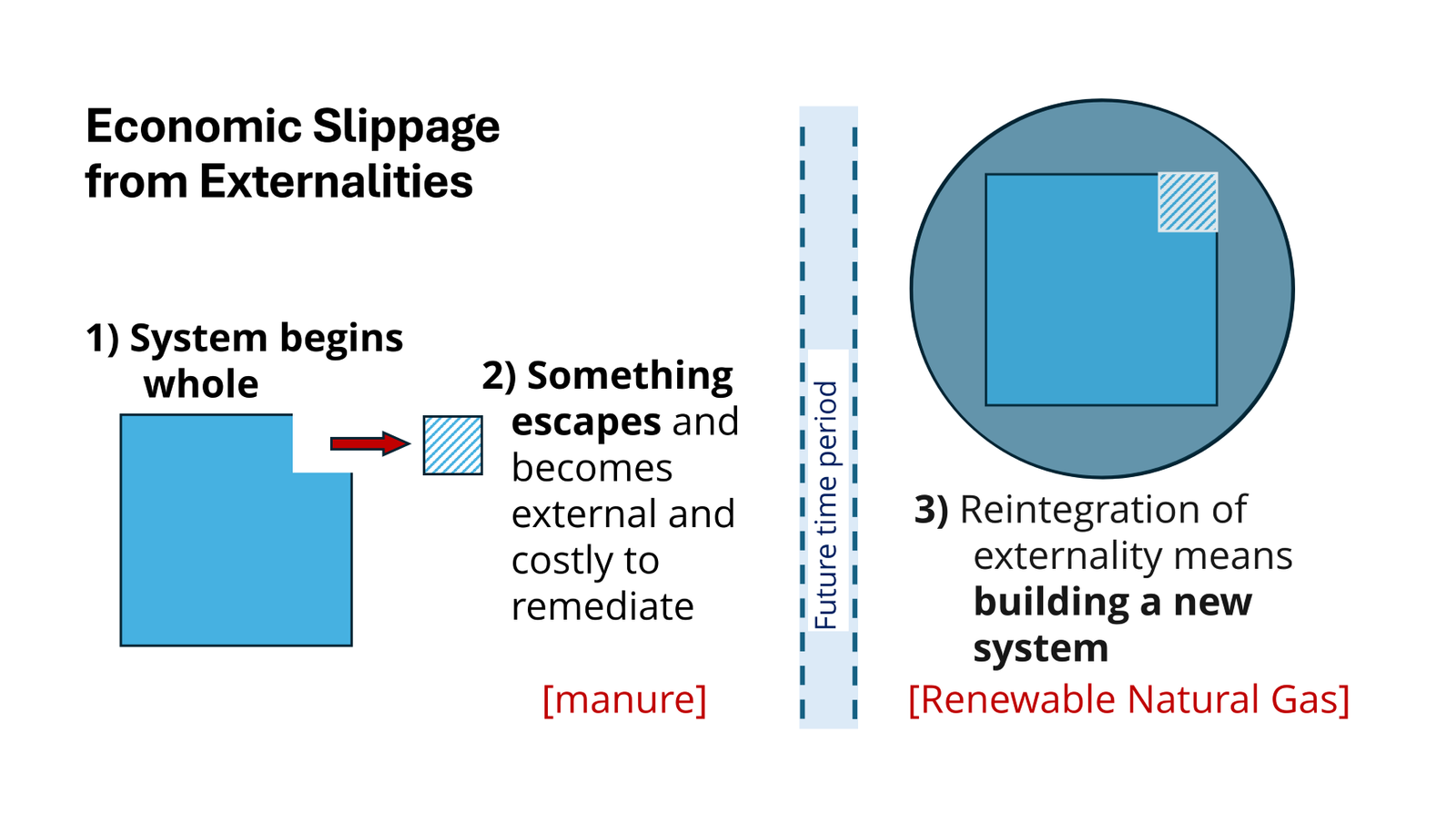
Using manure as an example the chart explains a 3-step process for managing externalities,
- The economic system begins as a complete system. Farms were growing food and contributing to a healthy US economy, when the Clean Water Act was signed into law in 1972. This created a legal benchmark for responsible manure use, and over the next few decades, higher compliance costs to meet the standards. While in the early 1970s manure water quality problems were not national news, the codification of manure regulations defined manure as an economic externality at the stroke of the pen (signing of the legislation).
- An externality escapes the economy and requires an external definition. Universities, support industries, and farms worked with state and federal government agencies to remediate manure-derived problems for the next 4 decades (yes, forty years). One of my professional trophies was to be an active participant for over a decade in the National Poultry Waste Management Symposiums (as well as the US Composting Council). Biomass Rules’ primary billable service in the 2000s was conducting feasibility studies on compost and anaerobic digester enterprises for those entrepreneurs. From the 1970s to the 2010s, the United States was in the process of defining the problem. There was lots of work being done in finding solutions, but it was largely experimental.
- New systems internalize the externality losing the direct (linear) connection. By 2020s, renewable natural gas (RNG) was beginning to drive the installation of anaerobic digester systems in an unprecedented rate of growth/installation. Commercial composting operations have come into their own steadily over time. Emerging new industries shift the focus on what is causing the problem (externality), to how fast these new industries can grow in the economy.
The new economic systems that provide new life for former economic externalities, lose the former change-driving connection. Or, the emerging solutions bypassed original problem completely. For instance, the exciting expansion of the RNG industries is not dependent on manure water quality standards of the 1970s or the 1990s. The focus is on the availability of non-fossil energy that has over many innovations become cost-effective to produce.
There are multiple feedstocks from very different industries that contribute to RNG opportunities. The top three are the landfill gas industry (solid waste), manure, and food waste. Wastewater (sewage) is also in the RNG feedstock mix. This is an intergenerational shift in efficiency from 1) unawareness of leakage, to 2) problem definition, to 3) economic growth. And it is pretty exciting.
As this post goes public, there are two related conferences occurring this week in May 2026 on related topics.
- The ReFED Food Waste Solutions Summit, May 19-21, 2026, Charlotte, NC.
- The Biogas Americas 2026, May 18-21, 2026, Detroit, MI
The ReFED Summit is doing important problem definition work regarding food waste with the hope of leading to solutions. But there is a struggle in that path of the heavy focus on the problem definition to the point of interference in leading to successful solutions.
The Biogas Americas focus is finding economic growth solutions within the boundaries set by the food waste problem definers. Food waste is a valued feedstock for current and future economic opportunities.
There are individuals and companies that are active in both of these communities. Larry Cole was correct in his counsel of my public facing support for elevating contract grower problems and solutions. He was the master of doing both (definition and solution). But his point to me on that issue was if too much attention is paid to the problem definition, the future solutions cannot progress. Unsaid was an inference that at some point, there has to be less attention on the problem definition and more attention on solutions and opportunities that are not directly connected back to the original external challenge.
Both of these groups are doing important and exciting work. The point of this post is that there are differing roles in defining economic externalities, and then, in reintegrating the external components back into a smoothly functioning economic system. Once and economic externality is identified, it is not automatically an additional cost to the economic system. But re-internalizing and external component of the economy is not automatic. If it is not managed correctly, future economics systems will move forward without reintegration of the former external component.
Comments
Solutions to Economic Externalities Require Both Problem Definition and Vision — No Comments
HTML tags allowed in your comment: <a href="" title=""> <abbr title=""> <acronym title=""> <b> <blockquote cite=""> <cite> <code> <del datetime=""> <em> <i> <q cite=""> <s> <strike> <strong>