
The World, the Economy, and Food Waste Management, are not Flat
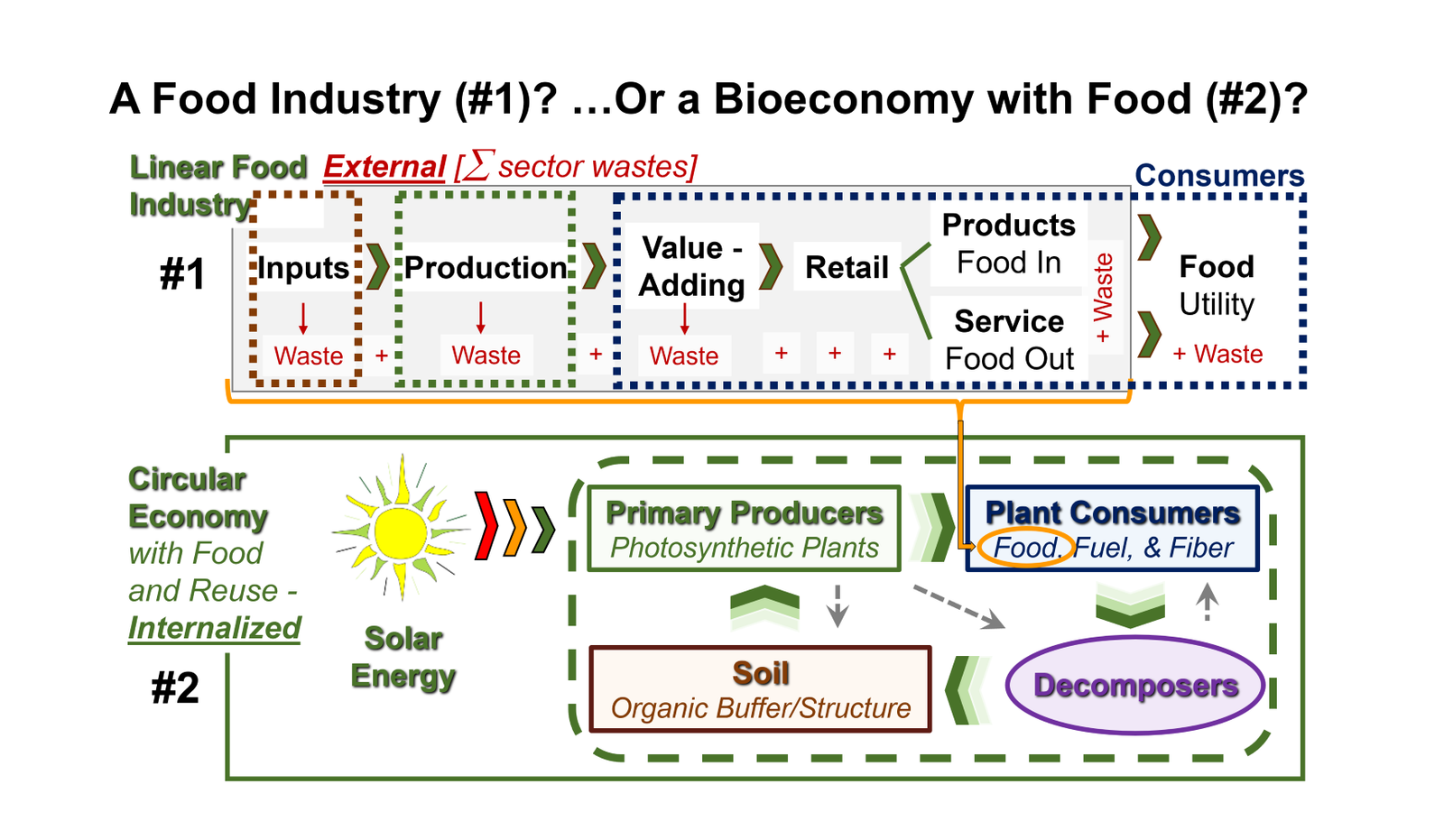
We do not live in a straight-line world. Although food markets are much easier to navigate in 2 dimensions. A linear, food industry supply chain makes intuitive sense when thinking about inputs > farming > processing > retail (Model #1 in the attached image). This food supply chain is the foundation for managing markets and annual production decisions because FOR THESE CHOICES, THIS IS THE BEST VIEW!
This linear view does not get the job done when looking to solve food waste challenges. It does help in initially defining where there is economic leakage in the single objective of producing food in the food system. It does not provide context for solutions within the economy.
Food waste, by definition, is in the wrong place and creates a system imbalance. Without adding value, it is an economic externality. To pull food waste economic slippage back into the economy, it takes a systems view. Our economy is built upon an intergenerational production ecosystem. Products and byproducts move between industries and across time in ways that cannot be resolved in a linear industry model. The bioeconomy model, soil > green plant producers > plant consumers > decomposers, is much more useful. This is Model #2 in the attached image. When viewed from the top down, the food industry is simply a cog in the system. Food waste as an economic externality is even less significant.
The bioeconomy thrives on reuse. The system facilitates food waste byproducts being pulled back into productive use again in the economy. Economic externalities can be re-internalized. To do this the production leftovers with a negative value move outside the straight line, to another production supply chain. Dairy manure can become inputs into other operations such as nutrients and energy and bedding. The value-adding process requires 1) the most appropriate conversion technology and 2) it must meet a need. The byproduct requires a supply (technology and infrastructure) and demand.
Moving corn into ethanol production (10 percent of the US gasoline fuel supply), distillers grains (feed), and oil (food) does not happen in a food supply chain, or separate fuel or feed supply chains. It needs a system of multiple markets to function.
The linear food industry model is not simply a subset of the circular bioeconomy. They cannot be easily aligned for comparison.
The bioeconomy model has 1) soil, 2) plant producers, 3) plant consumers and 4) decomposers.
The food industry model in comparison can be loosely aligned with 1) inputs (soil), 2) producers (farmers) and 3) food consumption industry. This is more post-production than pure consumption. The components do not line up conveniently. Lining the models up requires relaxing the definitions. Then there is the 4th component of the bioeconomic model, Decomposers. This shows up in the food industry supply chain as disposal costs. Each independent food industry sector has disposal costs imbedded into their profit margins. Everything is one-way (passing through the model). Reuse cannot be identified in the traditional food industry supply chain.
Looking for food in the bioeconomic model requires more imagination. It is traditional to think of agriculture as food. In reality – economically, environmentally, energetically, structurally (building materials), and socially – it is much more than food. In the Circular Economy, food is part of the story. It should be noted that there is more to the circular economy than photosynthesis. But the reuse component shows up in both the circular and bioeconomy models and is absent in the linear industry models.
The dimension that is critical but missing in both of these conceptual models is time. Biofuels, including renewable natural gas (RNG), have come into their on in the last 20 years. Similarly, whey protein has become a valuable and currently scarce food ingredient when only decades ago it was disposed of as an economic liability. We now have a private space industry that up to now was funded by government resources.
Periodically, the USDA, Economic Research Service (ERS) presents the impact of agriculture on the US GDP. Biomass Rules has modified the presentation of this data and posted a version of this in an early blog post. ERS includes forest products, fisheries products, tobacco, alcohol, and textiles, in the production stages, but only looks at food and beverages at the retail level. There are no: agricultural energy, building materials, environmental services, or agritourism included at the retail level. It is not a chart of US food production. ERS labels it ‘agriculture and related industries’ which is undefined as a label.
Not that far in the distant past, the idea that the world was flat was common knowledge. Twenty years ago, Thomas Friedman wrote, “The World Is Flat: A Brief History of the Twenty-first Century”. It was an illuminating and enjoyable summary of how rapidly technology and globalization had changed our culture. Those changes made the world more accessible to everyone on the planet. Now, in 2026, the nations on Earth have moved away from that model of trade and market transparency. There are indications that this open-trade model began to unravel with the 2008-2009 recession. It has notably changed even more with the first Trump presidency, the COVID pandemic, and now the second Trump presidency. But it is not only a US phenomenon. In the context of Thomas Friedman, the world is becoming less flat. This is also true in understanding food waste.
But in the case of the food industry linear supply-chain model vs. the circular bioeconomic model, the nature of the flat, straight line trades simplicity for managing multi-level economic transactions. When the only focus is on understanding food markets, the linear supply-chain model is ideal. For understanding food waste, the linear model is confounding. Food waste solutions are not flat.
Comments
The World, the Economy, and Food Waste Management, are not Flat — No Comments
HTML tags allowed in your comment: <a href="" title=""> <abbr title=""> <acronym title=""> <b> <blockquote cite=""> <cite> <code> <del datetime=""> <em> <i> <q cite=""> <s> <strike> <strong>