
Greenville University Agribusiness, a Decade of Program Success
In 2016, I was invited to build a 4-year agribusiness program at Greenville University (GU) in Greenville, Illinois. We did it. Success is sometimes difficult to measure, but in this case, success is a measure of achieving our goals and doing it well.
Greenville, Illinois is a rural county within the St. Louis Metropolitan Statistical Area. Bond County provides a commuter labor force to St. Louis and the urban communities surrounding it. But when the Greenville University business classes invite guest speakers into their classroom from local businesses, they are likely area successful agribusinesses. Purdue University and US Department of Agriculture (USDA) keep track of the current and future job opportunities for graduates in fields in food, agriculture, natural resources and environmental industries. Their work indicates that the demand for agribusiness graduates is larger than the existing infrastructure that provides agribusiness graduates. Greenville University set a course to enter the supply chain to provide ready-to-work, agribusiness graduates.
Agribusiness – for the purposes of Greenville University – was defined as the formation of critical thinking, business managers that were fluent in thinking, speaking, and writing the language of agriculture. Resources were limited, but advances in technology brought the world to the classroom through the internet and spreadsheets.
Biomass Rules readers know that we enjoy looking at all the different flavors of agribusiness. There are many lenses with which to examine US agribusiness. Which lens is the proper definition from which to develop a 4-year academic degree program? Previous agribusiness boundary discussions include:
- National Ag Day and the Role of Agribusiness in the Economy, March 27, 2026
- Local Agribusiness Economic Study Delivered to St. Louis Agribusiness Club, September 25, 2025
- Unpacking Applied Academic Agribusiness Programs, April 3, 2025
- Turning Straw into Gold, the ‘Rumpelstiltskin’ of Leftover Organics, October 8, 2024
- BioTown, USA – Sourcing Local Biomass Energy Feedstocks, September 19, 2024
- Community Wealth Creation Reflects Both Micro and Macroeconomics, July 11, 2024
- Agribusiness Markets Go Well Beyond Food, March 26, 2024
- Academic Agribusiness in a Microeconomic Model, March 21, 2024
- Discerning Agribusiness in the Macroeconomy, March 21, 2024
- What is Agribusiness? A Good Place to Begin…, March 21, 2024
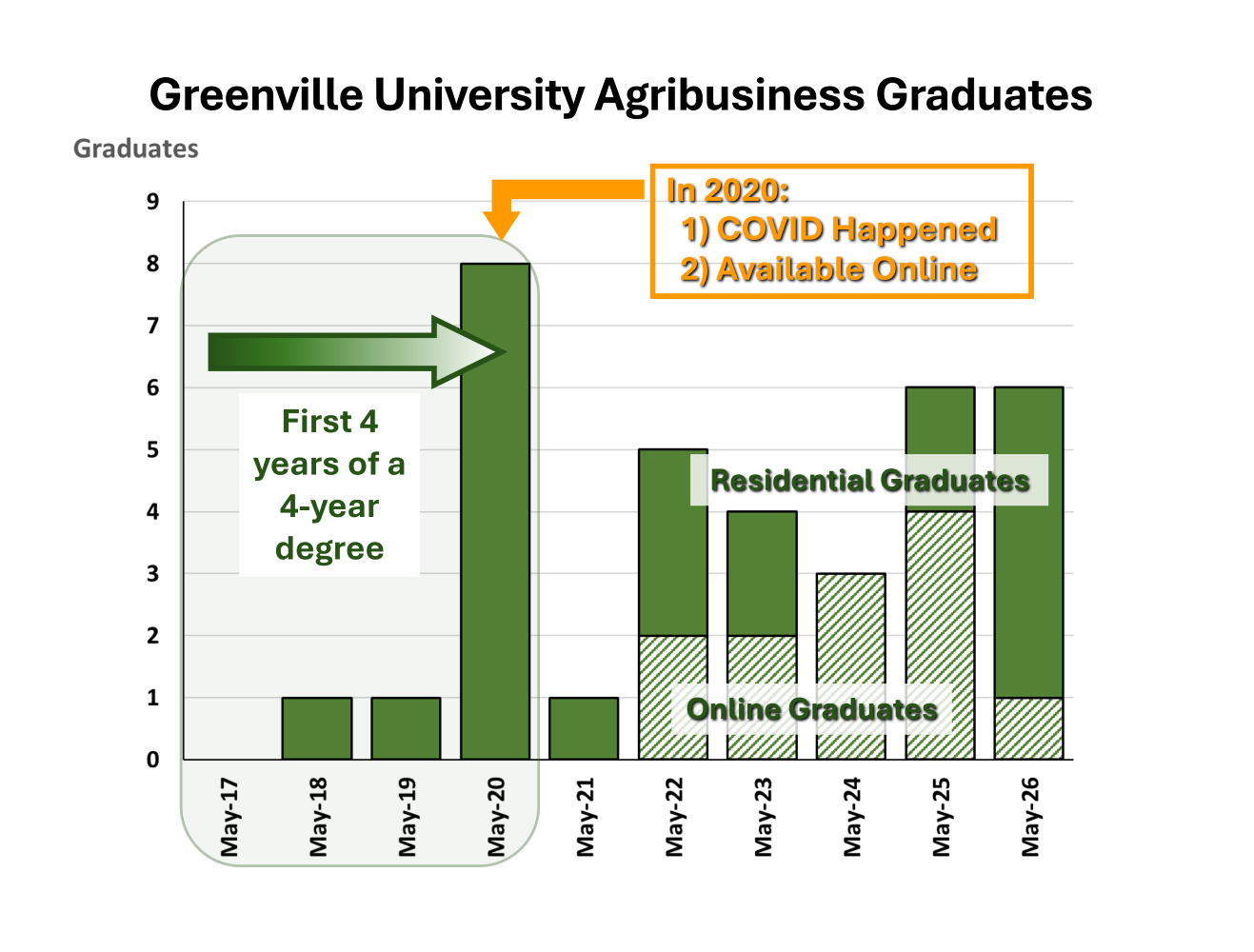
Greenville University commencement for the 2025-2026 class was held last weekend, May 9, 2026. There were five residential agribusiness graduates and one online agribusiness graduate. Historically, there have been about 200 University graduates each year. It is a small school, so the numbers are relative. I made the point that University of Illinois, had 62.3 percent of the state’s 4-year, undergraduate ag students in 2022, and Greenville University had 0.3 percent of the state’s 4-year undergraduate ag students. When combined, U of I and GU together, approached 63 (62.6) percent of Illinois’ enrolled students in 4-year ag programs.
The GU curriculum began modestly with four dedicated agribusiness courses included in the rigorous business curriculum. GU produced 10 agribusiness graduates in the first 4 years of the 4-year program. In year three, the agribusiness recruiter took a different position out of state and the agribusiness recruiter position was not filled. In year four, COVID hit. That was a shock that disrupted all of education. Unexpectedly that difficult pandemic crisis created a challenging, but beneficial program development of the Greenville University online agribusiness program.
This shift to both a residential, on campus curriculum and an online curriculum, brought consistency and discipline to both programs. Great lessons learned include:
- The original four, 16-week agribusiness classes, in hindsight, were overloaded in material (too much), in an effort to create graduates fluent in agriculture (in just 4 classes).
- The online classes were only 8-weeks long. The agribusiness classes increased from 4 courses to 7 courses.
- The online classes also defined the core baseline curriculum for each of the seven agribusiness classes. In the residential, on campus classrooms, there was room for additional excursions in each topic.
- While I was teaching at GU, the director of the agribusiness program also taught the analytical business and economics courses in the business school. So the two semesters of economics and operations management contained ample agricultural examples and illustrations. The economics textbook was not an agricultural economics textbook, but the GU agribusiness students learned everything a student in an agricultural economics class would learn by the time they graduated. Even though there was no ag econ course in the curriculum. It spurred interesting questions about what an ag econ textbook looked like compared to an econ textbook taught by an ag economist?
Of the 35 GU agribusiness graduates in the first 10 years, 35 individuals could think critically, developed business management skills and were fluent in thinking, speaking, and writing the language of agriculture. Compared to the pool of all US graduates with BS in agribusiness, the GU agribusiness graduates were above average.
For reasons that are beyond the success of the agribusiness program, Greenville University has moved to a single business major with areas of concentration in management, accounting, agribusiness, and marketing. The first decade of operating a complete standalone agribusiness program have equipped them well for operating an agribusiness concentration well.
All of the Greenville University agribusiness graduates have been successful, though not all have continued to work in agriculture. The real success of the GU agribusiness program was the energy that the students brought to the classroom.
As the 2026 GU agribusiness graduates received their diplomas last weekend, it was gratifying to be help guide 35 young agricultural professionals for a minute early in their journey, as they sat through their coursework. In a small way, I have trained up nearly 3 dozen leaders and agricultural ruckus makers to fix the things my generation couldn’t quite straighten out.
Comments
Greenville University Agribusiness, a Decade of Program Success — No Comments
HTML tags allowed in your comment: <a href="" title=""> <abbr title=""> <acronym title=""> <b> <blockquote cite=""> <cite> <code> <del datetime=""> <em> <i> <q cite=""> <s> <strike> <strong>