
Farm-based Rural Leadership Account of Philip Bradshaw – A Worthy Read
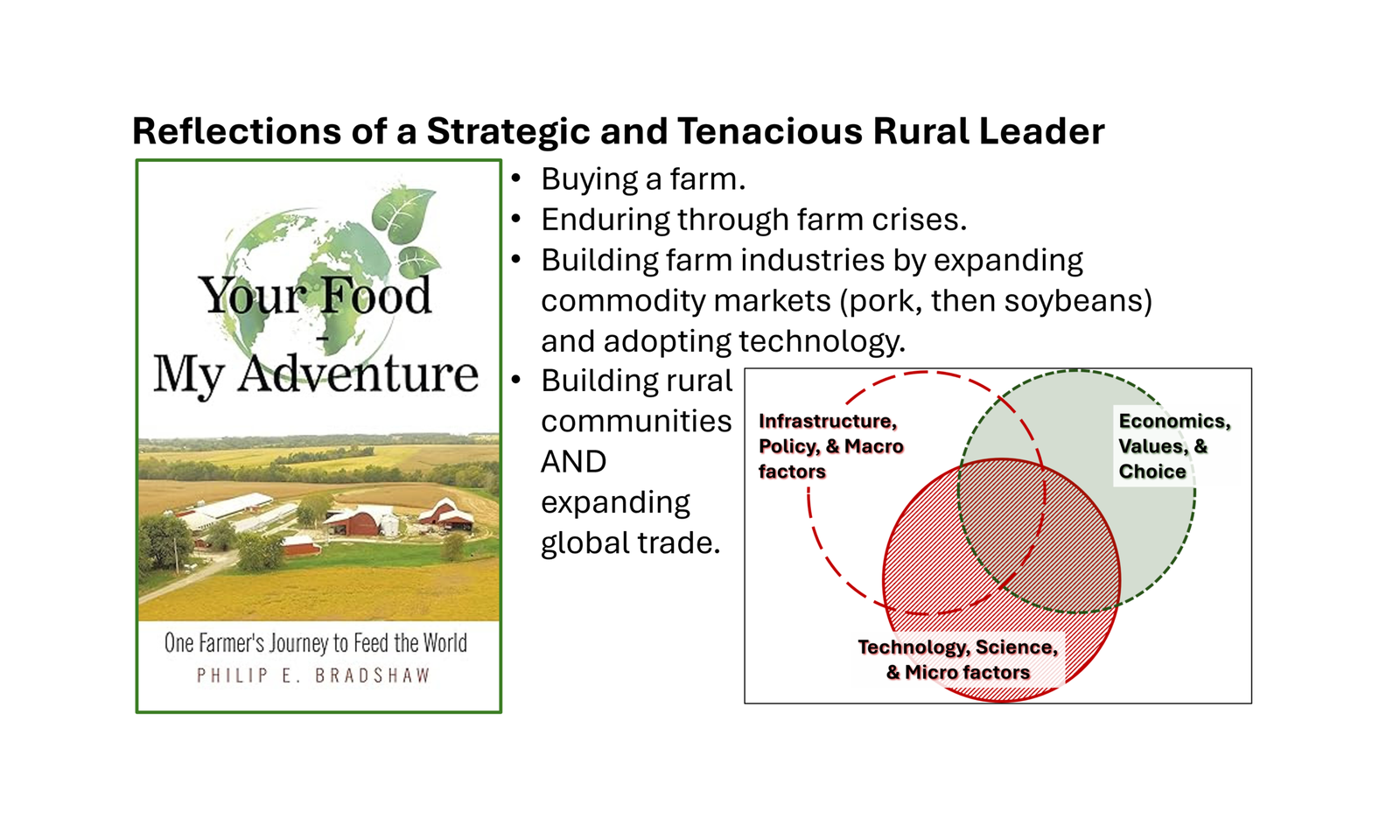
One of the quiet benefits of membership in the St. Louis Agribusiness Club, is getting to know Club members like Philip Bradshaw, a retired farmer from Pike County, Illinois. At the April 2026 meeting, Philip reintroduced his 2019 book, Your Food – My Adventure: One Farmer’s Journey to Feed the World, to the club. I bought a copy and read it. It was a good investment.
The best part of this case study in farming community leadership is that it elevates the difficult to measure leadership and volunteer energy that has transformed rural America. In an environment where young minds are perennially moving to urban centers for professional success and access to technology and activities, rural areas – led by farm families – continue generate economic growth. It is not easy and it is not fast money. Rural areas are the costly to bring in access to communication, food access, and often educational opportunities. Labor supply is in excess of naturally-occurring job opportunities and at the same time, too scarce to feed a large industry project.
But farming communities have stayed alive, and occasionally even thrive, by:
- Forming cooperatives to bring in farm inputs, rural electricity, insurance, and even technical expertise.
- Organized commodity check-off programs over decades to expand markets for generic commodities that cannot be promoted as retail products can.
- Opened up global trading opportunities.
- Trained up elected leaders from both farming and non-farming communities on critical understanding of the needs of rural families and farm businesses.
- Navigated economic crises and global conflicts as business owners (farms).
- Shaped local solutions for community success from external macro-level events.
- Built strong marriages and intergenerational families.
Phil Bradshaw shares his humble path through all these things spanning the dynamic changes in technology and policy. When he was a boy, his family relied on draft animals and walking bean fields with hoes. Now his children and grandchildren farm with combines and planters that are guided by satellites.
Biomass Rules looks at agriculture through the lens of market infrastructure and policy (macro supply), science and technology (micro supply), and consumer choice and economics (demand). It is human nature to look for simple answers to difficult challenges. But even with these three facets of an agricultural economy, any single issue has three different contexts. Success at mitigating challenges requires a successful solution for each of these facets. “Your Food – My Adventure” supports all three of these facets as Mr. Bradshaw weaves his story across eight decades.
Other messages that are less explicit are 1) the countless volunteer hours devoted to moving important values forward, 2) the energy and confidence to rise to leadership opportunities that appear, and 3) the difficult discipline of balancing business, community service, and devotion to family.
When I worked for the American Farm Bureau Federation, I was struck by this organizations ability to implicitly capture all of these complex ideas into their mission to promote production agriculture. They did not try to focus on a single attribute, or even a single commodity. But in my experience, they have done well at providing a forum for all these values, which sometimes conflict with themselves, and move the entire package forward.
That career experience for me was thirty years ago. And in the subsequent career space between: biomass energy development, commodity and environmental forecasting, farm extension, agribusiness in higher education; there has still been a quiet attempt to quantify what makes it all work.
Philip Bradshaw captured the essence of these complex values, both directly and indirectly as he brings the reader through his farming adventures. It is a good read for everyone attempting to sort out farming success and rural community values.
Comments
Farm-based Rural Leadership Account of Philip Bradshaw – A Worthy Read — No Comments
HTML tags allowed in your comment: <a href="" title=""> <abbr title=""> <acronym title=""> <b> <blockquote cite=""> <cite> <code> <del datetime=""> <em> <i> <q cite=""> <s> <strike> <strong>