
Where Have All the Domestically Produced Manure Nutrients Gone?
We are still using them.
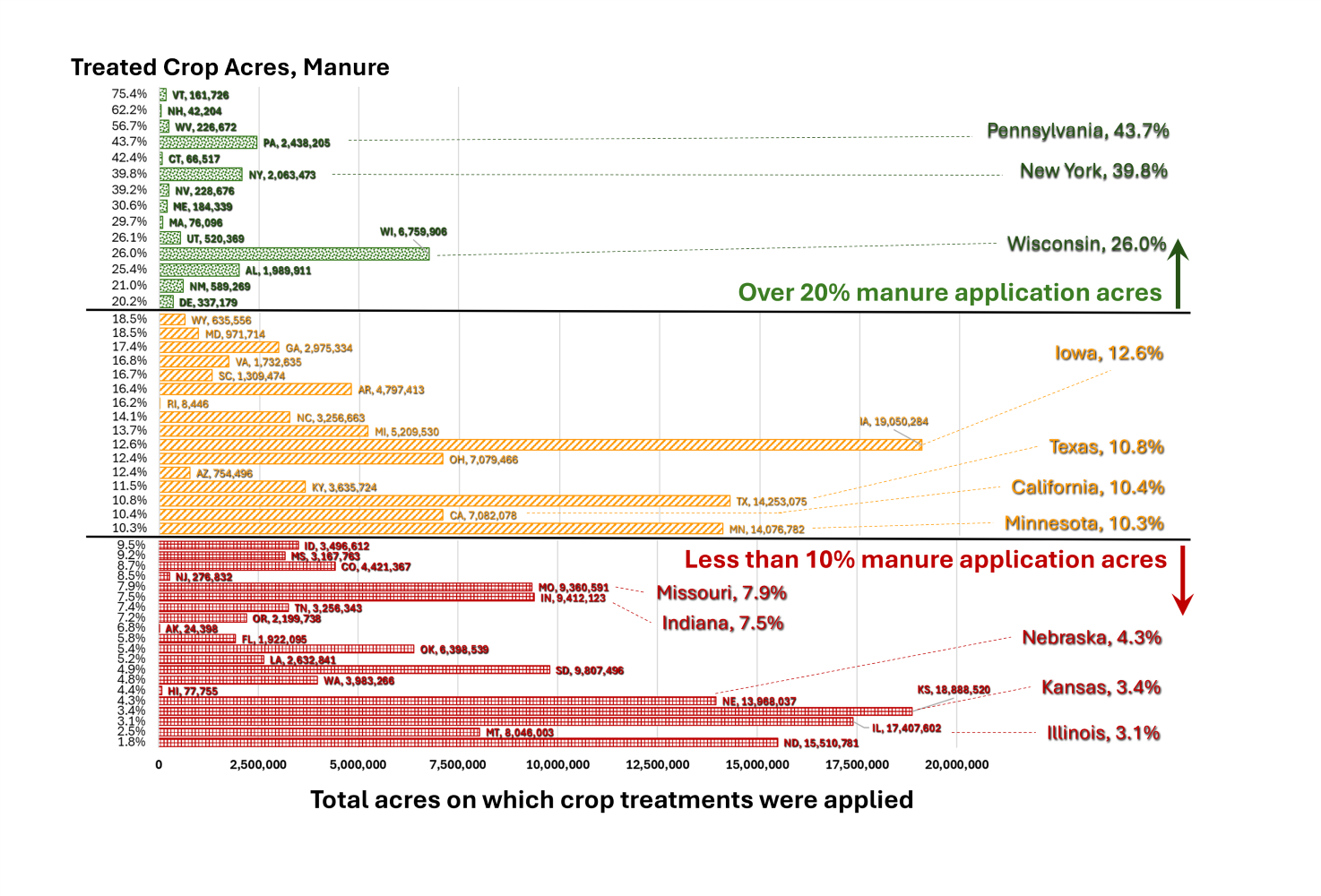
This chart is from the data in the USDA, 2022 Census of Agriculture, Volume 1, Table 40, Fertilizers and Chemicals Applied: 2022 and 2017. It is convenient that the Census of Agriculture now contains manure utilization data. The data collected and reported over the years changes very slowly. Too many changes disrupt continuity for long-time data series. Usually, more data is collected than reported. When a data item such as manure or industrial hemp production reaches a threshold, the collected data is also reported.
Treated acres is a very specific filter. It originated as a measure of chemical use, so acres of chemicals applied. Commercial fertilizer is one of those chemicals. Manure is traditionally utilized as a source of fertility, so eventually, manure was included in the acres treated with chemicals. While acres treated may include any kind of land, it is generally a proxy for cropland.
This chart shows the percentage of treated acres that are treated with manure. It generates more questions than it solves. But the best value of this chart is that manure is still actively used as a fertilizer in the United States, and we can document it.
Things that are really interesting:
- Vermont applies manure on 75 percent of all acres that are treated. It is a small state with a significant dairy industry (manure supply).
- Pennsylvania (44 percent manure acres), New York (40 percent manure acres), and Wisconsin (26 percent manure acres) are larger states with significant manure supplies (livestock production).
- Iowa reported 13 percent manure application acres, and Texas, California, and Minnesota, reported 10 percent of the manure application acres.
- Other states with large crop production sectors reported applying manure to less than 10 percent of their treated acres.
Everyone is using manure as it is available. This chart represents more of a balance between cropping acres and livestock manure supplies. States with fewer manure application acres are 1) farming millions of acres of cropland, and 2) making more than one kind of chemical application.
There are many things that this chart does not provide:
- Nutrient quantities. No manure nutrient quantities. No commercial fertilizer quantities. No non nutrient quantities.
- Manure nutrient sales are limited. Recall that fertilizer sales are regulated for guaranteed analyses. It is very difficult to guarantee a meaningful manure nutrient level, so manure nutrient utilization is often used on ones own crop acres. Though much moves off site, just not on a nutrient value basis.
- Manure fertility use is generally limited to the location in which the manure is generated. It is costly to transport. So if the crop nutrient demand is not located with the manure nutrient supply it is not feasible to use for crops.
- Grazing animals on pasture are not included in treated acres. Grazing animal manure is a hidden transaction in this data.
- The nutrients in manure are typically not generated in the levels required by the crops. Crops receive higher levels of nitrogen. Manure often has lower levels of nitrogen relative to the levels of phosphorous in the manure.
Domestically produced manure nutrients are available and utilized in this time of high fertilizer prices. They are not a convenient substitute for the levels of crop fertilization that we require for current crop production.
There are both historical and emerging technologies that may provide some alternatives to the conventional fertilization application practices in these difficult times. None of these alternatives are direct substitutes to fertilizers. But leveraging available organic buffers, nutrients, cover crops, emerging biologicals, and variable rate drone applications to the most productive areas of the fields, farmers will navigate their way through these difficult times.
Comments
Where Have All the Domestically Produced Manure Nutrients Gone? — No Comments
HTML tags allowed in your comment: <a href="" title=""> <abbr title=""> <acronym title=""> <b> <blockquote cite=""> <cite> <code> <del datetime=""> <em> <i> <q cite=""> <s> <strike> <strong>