
US Dairy Farms Keep Lowering Methane Emissions
The fierce and relentless innovation of US farmers is uplifting. Some farms, particularly US dairy farms, can serve as a scapegoat for methane production. This 2023 Journal of Dairy Science article by Jeffrey O’Hara, State-level trends in the greenhouse gas emission intensity of US milk production, has more than one interesting contribution. Dr. O’Hara serves as the Deputy Director, Office of Energy Policy and New Uses at USDA.
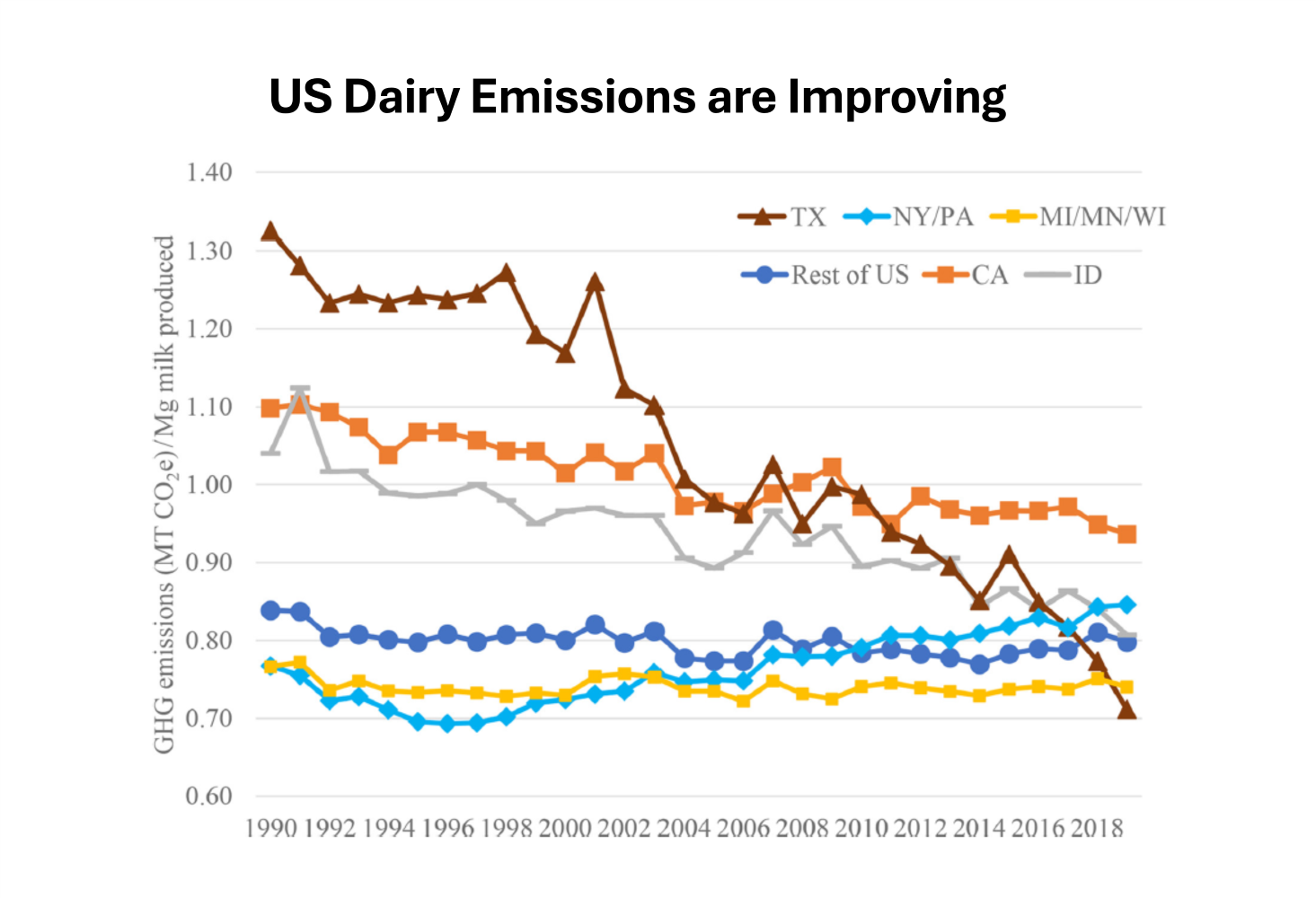
The chart in this post is one of a series of three similar charts in Jeffrey O’Hara’s article. It shows that combined enteric (digestive) and manure-derived methane emissions have been constant or declining per metric ton of milk produced, …by state. Three notable things that are embedded in this one chart are:
- For EVERY state and US group, methane emissions have been declining since 1990 on a unit of methane per metric ton of milk produced.
- For states with large expanding dairies (TX, CA, and ID) manure derived methane is also declining since 1990. For the other state and US groups (MI, MN, WI, NY, PA, and rest of US), manure methane has been increasing. As state dairy farms decline in size and number, the most efficient manure management options decline.
- The chart presented here is the sum of the first two relationships (enteric methane + manure methane emissions per metric ton of milk produced since 1990.
Smaller dairies are declining and larger dairies are expanding. On a methane emission basis, more dairy cows are reducing their emissions with a smaller number that on average are holding their overall methane emissions constant.
A favorite aspect of these dairy methane emission relationships is that since 1990, dairy farmers have been successfully addressing methane emissions as opportunities emerged. Their primary focus has been to do the best job of producing high quality, cost effective milk. By fulfilling that primary objective well, a secondary benefit has been the consistent decline in enteric methane emissions across all states indicates that dairy cows are utilizing more of their feed and emitting fewer unwanted byproducts.
Last month, Biomass Rules wrote about the well known USDA relationship of farm total factor productivity (TFP). US farmers are very good at producing more output with constant or declining inputs. This is well established.
- The TFP looks primarily at marketable products per inputs used.
- The methane emissions in today’s chart look at a reduction in unwanted byproducts.
- Depending on the lens that is applied, it is possible to get conflicting views.
In June 2026, ReFED and WWF produced a report on food loss in the US dairy supply chain. Their laser focus of the market of only future food products falls short of the interdependent system of production objectives on today’s farms. Food production is not the only reason farms produce marketable products and services. Using food production exclusively as a measure of success is too myopic, and produces a distortion in the reality of farm production.
One ReFED-identified item of US dairy farm inefficiency is feeding milk from the cows that birthed calves to those same calves. Feeding calves milk from their own mothers is a natural and efficient method of getting the production of the next generation of cows growing well. It is not a production flaw.
Biomass Rules has made a living finding beneficial uses for farm byproducts. There is a beneficial service that food waste reuse organizations, like ReFED provide. But as a champion of US farm production for the same amount of years, it is conflicting when farm production information is lost in the food waste reuse objective.
Putting out nice looking reports does not relevant information make. The US farming community is sometimes slower to adapt than public information shifts public awareness. The last post reflecting on the statement, Everything We Know is Wrong, identifies a number of farm production shifts over the last 50 years.
US farmers are both innovative and responsive to new information. There is a cost to posting well-intentioned, but incomplete information. This requires constant vigilance.
Comments
US Dairy Farms Keep Lowering Methane Emissions — No Comments
HTML tags allowed in your comment: <a href="" title=""> <abbr title=""> <acronym title=""> <b> <blockquote cite=""> <cite> <code> <del datetime=""> <em> <i> <q cite=""> <s> <strike> <strong>