

Building A Better World with a Solid Decision-Making Framework
Recently, a family member asked the family broadly about everyday tasks that required an innovative solution. They are working on a masters degree class project. Soliciting ideas is a credit to the entrepreneurial spirit of this young professional. Of course, the broader family included me.
I sent the student some analytical aids that I have used in the past. I set down to share one of those tools here but realized that it is important to discuss the process in making informed decisions, first.
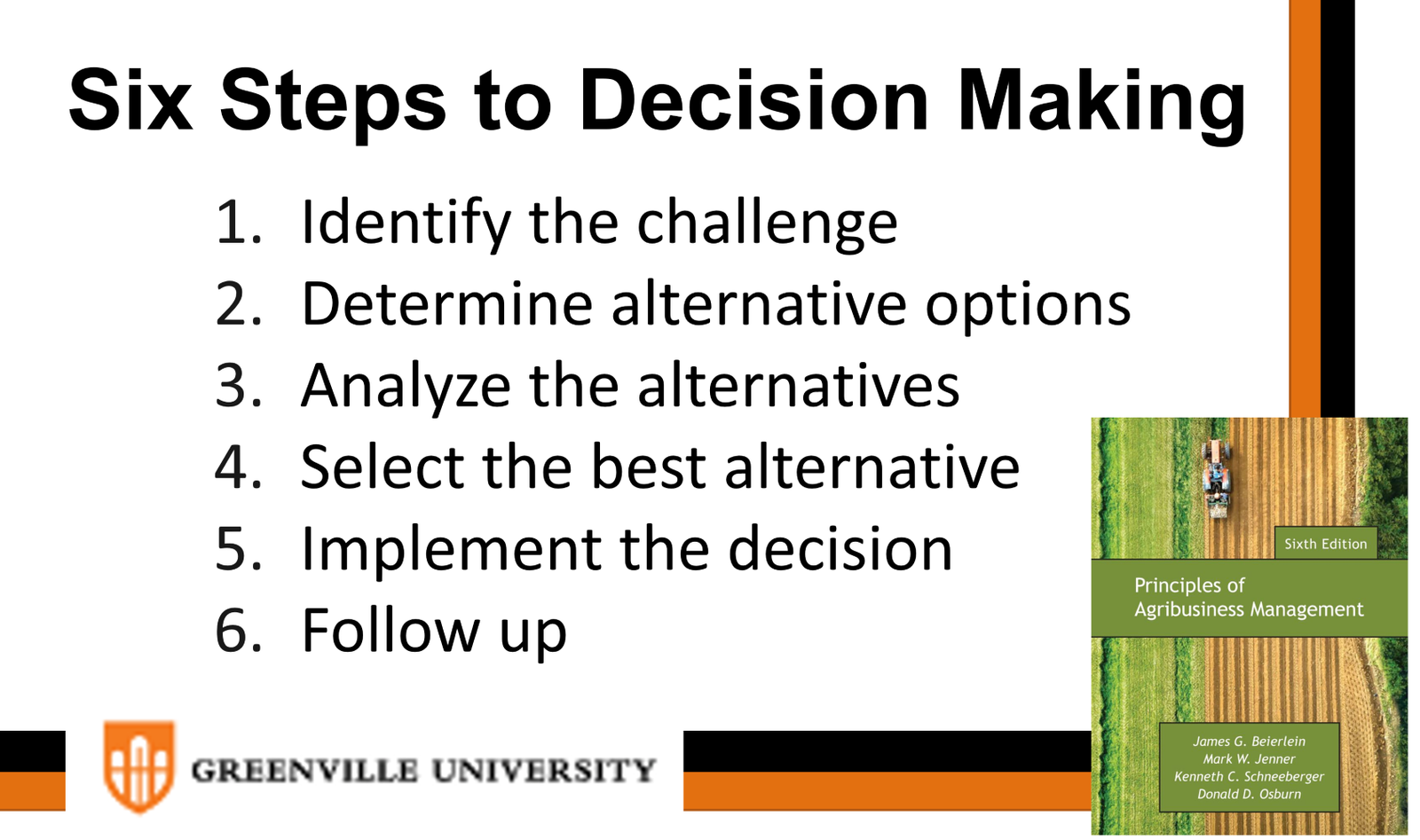
For me, and my students in the AGRI-101, Introduction to Agribusiness class at Greenville University, these six steps serve as an excellent foundation for any sort of business expansion decision. They are included in the Principles of Agribusiness Management text I was privileged to revise. The steps are:
- Identify the challenge.
- Determine alternative options.
- Analyze the alternatives.
- Select the best alternative.
- Implement the decision
- Follow up
This list is fundamental applied agricultural economics. If I were to choose a descriptor for the vision that I gained through my PhD in ag economics, it would include this list. Ag economists analyze choices. Often alternative options have no historical context, so they must be constructed, or modeled. (Identify options, then create a framework with which to compare them).
Then there is choosing or selecting the best alternative. These are easy when considering the opportunity costs (again, historical data not required). It does require confidence in knowing the incremental marginal benefit of the choice is greater than the incremental marginal cost.
Confidence includes selecting the proper scope of the challenge. This also includes selection of the best metric to compare alternatives. The go-to unit historically has been dollars ($). But over the last several decades successful analytics also include: time, nutrient balances, offset (non-monetary) costs, and of course carbon balances.
One of my modeling supervisors introduced me to the ‘purple face test’ criterion for successful modeling confidence. In other words, if when the model and assumptions are explained to peers – and their faces do not turn purple upon understanding what was done – it passes the purple face test. No red flags.
Questions and oversights are critical. They help refine the process.
One of the best advantages of rigorous analytics for decision making is that the cost of modeling future decisions accurately is far less expensing than investing millions of dollars before analytics are considered. As a consultant 20 years ago, it was not uncommon to get hired to explain why the conversion technology that had been purchased was not functioning as promised. Really? Often the analytics were not sufficiently inclusive, but sometimes an investor’s zeal for a quick solution simply overwhelmed the process.
The effort to create a decision-making framework does have costs, but even thousands of dollars are tiny compared to making the incorrect investment selection and purchase.
Making or implementing the choice that provides a unique competitive advantage for one’s business is worth doing. The analytics and selection must be done in a timely manner, but managers should not get distracted from execution of the selected pathway. Commit and invest.
Finally, continue to collect data and compare it with the earlier selection decision data. If the historical data collected from operation of the new enterprise diverges from the criteria on which the investment was made, it is better to know of this change sooner than later.
The opposite is also true. When the operation data matches the projected/forecasted results, it adds confidence to the business owners, managers, and investors. Step 6: Following up is not an afterthought. It is part of the program. Do it.
Making the best business decisions is not rocket science. It is, however, a tested discipline. It is a valuable exercise to identify alternatives for a given challenge, evaluate them, select the best alternative, make the decision, and follow up on the investment after the project has begun. This process also allows risks of what is unknown to be reduced by using the best available information that is known as a guide.
Comments
Building A Better World with a Solid Decision-Making Framework — No Comments
HTML tags allowed in your comment: <a href="" title=""> <abbr title=""> <acronym title=""> <b> <blockquote cite=""> <cite> <code> <del datetime=""> <em> <i> <q cite=""> <s> <strike> <strong>