
Catfish Farmers also Face Tight Margins in the Farm Economy
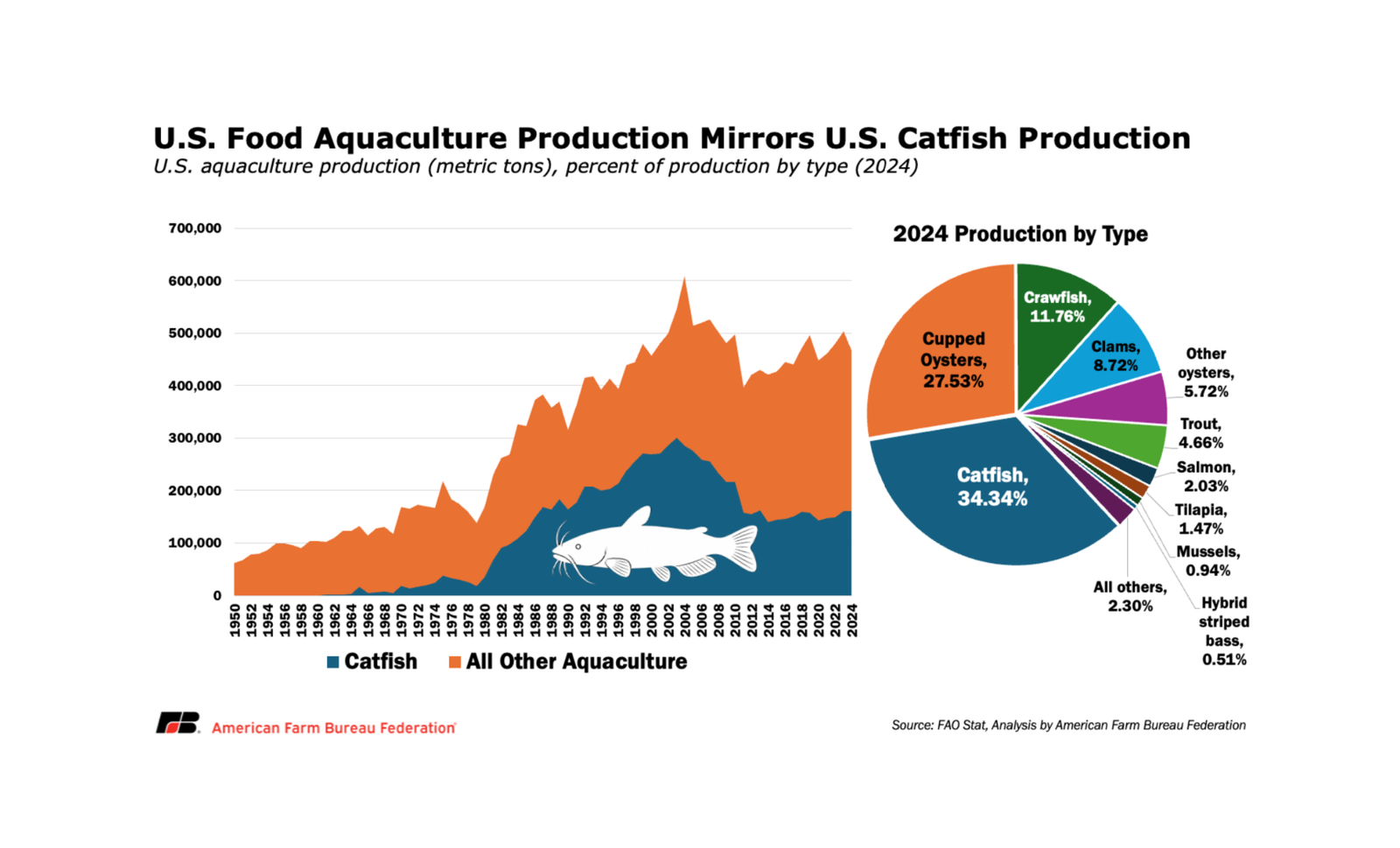
The American Farm Bureau Federation, Market Intel, and Danny Munch, just released a market outlook article on US Catfish Farmers: America’s Top Farm-Raised Fish Faces Growing Pressures. The current US Catfish farmer story is an account of grit and determination. It is a great article and worth reading.
Thirty One years ago, my first day as an economist at the American Farm Bureau Federation (AFBF) began in Washington, DC at public meetings on US aquaculture. I had 3 graduate degrees in manure management. None of them had anything to do with raising fish. I had an agronomy degree, had owned my own hog farm, and had worked in production agriculture on three continents (North America, Europe, and Asia). I had no fish farming skills. Still, before that 1995 meeting was over, I was unanimously appointed Chairman of the Coalition of National Aquaculture Associations. What? Everyone was most pleased that I had no fish farming experience, therefore, likely no aquatic species favorite or bias.
Over the next decade, we changed the world for US fish farmers. It was a roller-coaster.
Our AFBF Aquaculture producers petitioned the Secretary of Agriculture to recognize farm-raised fish as livestock. It was brilliant. Everyone understood that livestock were private property. Private property ownership, however, was not true of most fish. In the US, at least in the 1990’s, farm-raised fish lived in the waters of the United States. The wildlife protection laws gave the Department of Interior and Department of Commerce leadership in all fish, including fish that were farmed privately.
The 1990s were also a difficult time for US fish farmers. Getting health certificates to sell seedstock internationally, moving trout and salmon across state lines was illegal in the wildlife laws. In 1980, USDA claimed aquaculture as agriculture, but they had no prevailing authority to provide services to aquatic plant and animal farmers.
We made a ruckus.
We educated. Presented at meetings. Revised government plans. In uncommon ways, the individual national aquatic animal species groups worked closely with their state Farm Bureaus (Farmed aquatic species vary by region). As Danny Munch illustrates in the current AFBF article, US Catfish farms are concentrated in Mississippi and Alabama. I was a brilliant idiot, being advised by the fish-farmers that had everything to lose (or win). The individual national fish organizations understood the horsepower of AFBF taking the lead. It was beautiful.
At one point, I revised a draft National Aquaculture Development Plan that was under review. At a public hearing it became clear that the draft plan was focused on government fisheries, not private fisheries. I wrote an Industry draft and sent it out to the state Farm Bureau aquaculture leaders. They worked with their regional aquaculture groups to make it work for them. When it was ready to submit to USDA, I think all of the initial wording I had created in my initial draft had been replaced with words that better described what the fish farmers needed. It morphed into a Federal Register Notice. Ha, ha!
At a national aquaculture meeting in Florida, where the wildlife agency aquatic animal leadership had indicated that realized we were not trying to weaken their authority. After several years of making the case for increased USDA authority, that was huge! I returned back to Chicago only to be told that there were some farm leaders that were ready to fire me. Really?
It took about 10 years, but USDA was given statutory authority to provide services to US fish farmers. By that time no one who had started on this quest in 1995 was working on the issue anymore. But it was an authentic team effort.
I got out of agricultural policy before that happened. But since then, whenever a salmon disease problem is reported by USDA, I feel like I had had a rare privilege to have really made a difference.
Along the way, I learned some things about fish farming that were pretty amazing.
- We grow domestic sturgeon in the US for farm-raised caviar. This is nothing short of amazing to see. It is far more efficient and much cheaper than hunting wild sturgeon off the coast of Russia.
- Fish farmers must manage and supply oxygen to their animals. Not something the terrestrial livestock farmers spend time on.
- Farmed aquatic animals clean water supplies. Some species farming technologies can be harsh on water quality, but a number of species are bottom feeders that can improve water quality.
- Shepherding aquaculture for AFBF was treated like a single, commodity group. In reality is was an aquatic plants and animal kingdom of farmers. (I love crayfish, but really as crustations they are more like giant insects (an exoskeleton with 10 legs instead of 6)).
Likely my favorite fact about aquaculture is that farmed species have allowed the world access to affordable protein without depleting our natural fisheries. Overfishing pressure is ever present. But in January of 2025, Aquaculture is Planet-Saving Anthropogenic Food Production was posted here. In the last 40 years the growth of aquaculture – farmed crops and livestock – has allowed wild caught quantities to be sustained with farmed aquatic protein. As a global population we consume nearly double the wild-caught fish volume through farmed species, or aquaculture. We have doubled our consumption without depleting wild stocks.
Using farming methods to feed the planet is an appropriate use of our natural resources. It does demand constant vigilance to balance our needs with our consumption. But aquaculture, and farming catfish, is an efficient cost-effective way to deliver affordable protein responsibly.
Comments
Catfish Farmers also Face Tight Margins in the Farm Economy — No Comments
HTML tags allowed in your comment: <a href="" title=""> <abbr title=""> <acronym title=""> <b> <blockquote cite=""> <cite> <code> <del datetime=""> <em> <i> <q cite=""> <s> <strike> <strong>