
Unpacking the Latest ReFED Food Waste Impact Findings
Last year, I became aware of ReFED.org and their work on food waste. Their report, “From Surplus to Solutions: 2025 ReFED U.S. Food Waste Report,” was popular in the food waste circles. It is an impressive document and an even more impressive organization. Curiously, I found myself, a waste to revenue kind-of-economist, defensive about some of the claims.
In March 25, I posted my blog entitled, “Managing the Cost of Food Waste Inflation.” One of the things that was uncomfortable for me was a claim that 1/3 of all food was wasted. What? I have spent decades developing composting and anaerobic digester systems. Refeeding food waste has been driving livestock feed and pet food markets for decades. It became clear that the ‘1/3 of all food’ was tabulated before reuse was considered. The report also documented that over 60 percent of the wasted food was reused as food, feed, fuel, and other industrial uses. This means that over the course of food’s journey from inputs to residuals, 33.3 percent wasted food is closer to 13 percent or less when post-food use is considered (33.3 x 40 percent of post-food, non-beneficial use).
Other aspects were also troubling such as the term ‘surplus’ food. The report came out on the heels of an extended period of high food inflation in the US. One of the winter 2025 food price drivers was a shortage of table eggs. Economically speaking, food shortages are pretty much the opposite of food surpluses. High food prices conflicted with ReFED reports of high food surpluses. The ReFED-specific use of the term was different than what I was expecting.
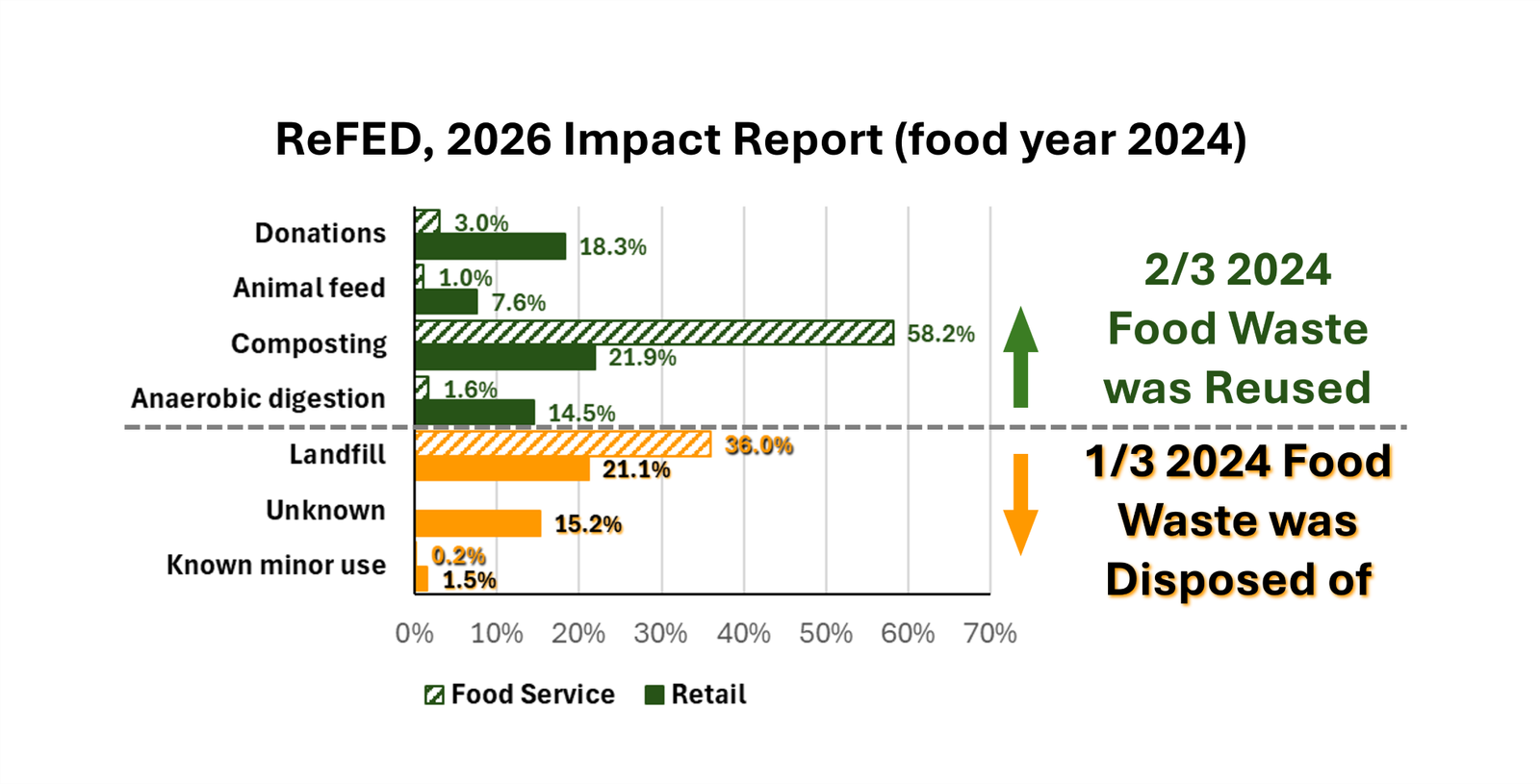
Earlier in March 2026, ReFED issued a, US FOOD WASTE PACT, 2025 IMPACT REPORT. This report summarizes work in food waste generation and recovery that was conducted in 2025 and included data from the calendar year 2024. There is a companion document released at the same time, US Food Waste Pact, 2025 Data Report. The chart in this post was created with data in these two releases. ReFED did a nice job addressing 1) retail (grocery store) retail food, or food at home, and also, 2) food service retail (food services), or food away from home. Both of these sectors have been combined into one chart in this post.
The ReFED work adds value to the food waste discussion. It is a 10-year effort working with food retail partners. This is a great beginning. Compared to the larger, traditional agricultural value chain, the food market is the largest subset of agricultural production. This ReFED food market waste-specific focus adds limitations also.
The ReFED work is transparent. The data sources and methodologies are publicly available. ReFED staff are approachable. Still there is a learning curve, even for a seasoned waste-to-revenue economist. As time permits, this body of work is becoming better understood with each report released.
Concerns that are still pending for me include:
- Valuation of unused food. The retail sector uses a retail food waste cost of unsold food. While this is an authentic number, it is also a construct, or estimate. It is not a value set by a market transaction. The food service value of lost revenue is determined by the wholesale price of food. This is a historical economic value, but it does not include other benefits and costs of diversions of those resources into other non-foodservice retail food uses.
- Expansion of forecasts beyond partner-supplied data. This is a tremendously valuable undertaking to grow a retail food partnership and build an authentic historical dataset that reflects their activities. The aggregation of food waste data beyond the pool of partners (54 percent of retail and 81 percent of food service) to the entire food industry is unclear.
- Casual inference to global food waste. The work done with the US partners is part of a larger global food waste-tracking network. Integrating the highly responsive US food value chain into a very different global food value chain is a worthy effort, but bringing global metrics to the US discussion has nothing to do with the US story.
- Food conversion volumes into refeeding, anaerobic digestion, and non-food energy options seem low compared to other feed and energy conversion experience. Livestock feed and pet food manufacturers are relentless at pulling safe nutrients into their feed formulations. Food waste fed digesters are an industry defined class of digesters. Used vegetable oil has become a significant feedstock into rapidly expanding renewable diesel fuel, with imported waste cooking oils outpacing the supply of domestic waste cooking oils.
- Most troubling for Biomass Rules, as farmer support and waste-to-revenue business developer, are the inferences to on-farm food waste volumes. This was a greater source of concern in the document released in February 2025, than in the reports released in March 2026. The primary difference was a vague reference to on-farm food waste in the entire system (2025 report) to on-farm food waste on one strawberry farm in the 2026 reports.
Biomass Rules is impressed with the ReFED work. The ReFED staff have been engaging in trying to help understand their documentation. Their 10-year history is relatively young as an organization. The 2026 food waste data released was easier to understand than the first release in 2025.
As a waste-reuse professional, we have to be ever-vigilant in asking the question, “How can we do better?” The ReFED organization and food waste reports are part of helping us define the problem.
Waste, and agricultural and food waste specifically, represent a dynamic container of underutilized resources. There is always a container of waste. But what passes through that container is always changing. The trick to accurately defining this problem is to focus on managing the container without adding feedstock-specific restrictions that impede future reuse of these underutilized and undervalued resources. As a nation, we are still learning how to do this in our industries and our policies.
Comments
Unpacking the Latest ReFED Food Waste Impact Findings — No Comments
HTML tags allowed in your comment: <a href="" title=""> <abbr title=""> <acronym title=""> <b> <blockquote cite=""> <cite> <code> <del datetime=""> <em> <i> <q cite=""> <s> <strike> <strong>