
Market Magic – The Science of Conjuring Functional Revenue from Waste Products
In 1990, I had the good fortune to discover the National Poultry Waste Management Symposium (NPWMS). What a tremendous group of scientists! For nearly 20 years, they met every other year to collaborate on adding value to various forms of poultry manure. They shared a common vision, ‘These organic manure and mortality resources should not be wasted.’
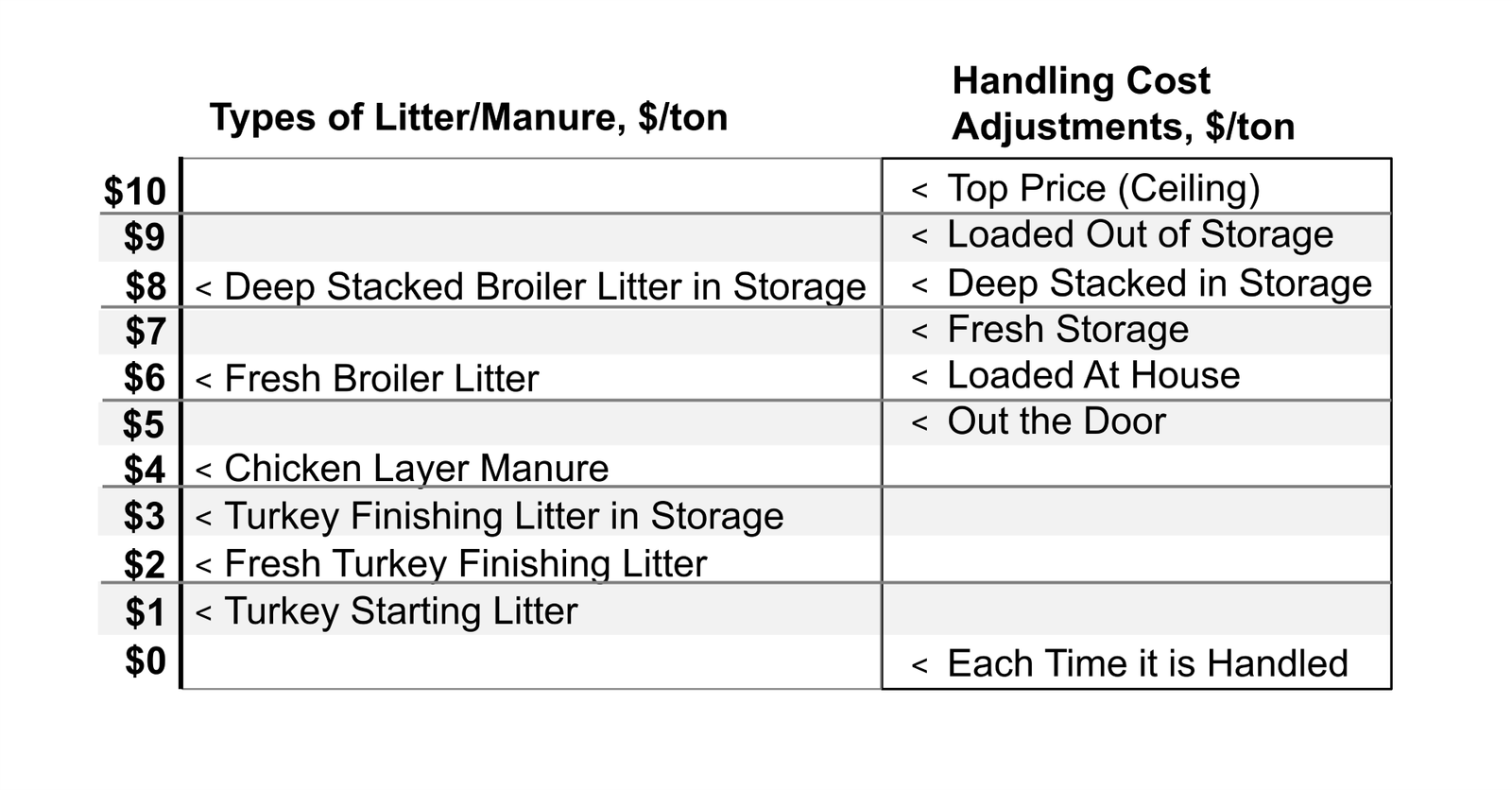
I had just completed my first MS in manure management (anaerobically digested swine manure) and was beginning my second MS in manure management (optimal broiler house litter cleanout frequency). This graphic was from this presentation: Weaver, W D., Jr. and G. H. Souder, 1990. Feasibility and economics of transporting poultry waste. Proc. 1990 National Poultry Waste Management Symposium, pp.123-129. It punctuated the science and simplicity of assigning value to products with little published data.
Gilbert Souder was a trucker. A lot of his freight was poultry manure (turkey and broiler litter and layer manure). This chart was based on years of experience. He knew his costs and what he could sell it for when he hauled it out of the sensitive Chesapeake Bay area. There was no market data, only his own history. He became the exchange for the manure he hauled. This trucker discovered the prices, and Dr. Weaver discovered him and published this work. Their paper was accepted for presentation at the National Poultry Waste Management Symposium, 1990. And as a graduate student, looking for solutions, I discovered the National Poultry Waste Management Symposium.
Economists call this sort of market magic, derived demand.
Two words: ‘demand’ and ‘derived’. Both are very powerful in this case.
- Demand, indicates the willingness of consumers to purchase goods and services. In this case, it was chicken and turkey manure that generally had a notable disposal cost. But here it infers that others DID want to purchase this good that poultry farmers were paying to get rid of. Also, for the first 20 years of my career, I was a technologist. I am a production economist. My passion is to build a better mousetrap. I invested much less energy into the demand side of farm products.
- Derived (demand), market values that are created indirectly from a public exchange. Most product prices come from sales data. Governments publish volumes of input and output product and price data that move through an exchange or retail outlet. In 1990, there were nearly zero published prices on the market value of manure products. But this presentation provided an authentic pricing structure that represented current prices for both poultry growers and farmers, and manure consumers.
Waste represents undervalued resources. My first degree was in agronomy, and agronomists define a weed as a plant out of place. Waste is typically a product out of place. Not only has my career been defined by looking for new places to utilize production system leftovers (wastes), but I have also been a study of the benefits and costs of the labels and words we choose to call products. Once a material is labeled as a ‘waste’ it usually costs more to convert it into a different productive use.
Early on in my association with the National Poultry Waste Management Symposium scientists, I had multiple conversations about the codifying of this game-changing group with the word waste in the title. I was assured repeatedly that they did that intentionally. There was a sense of pride in the group that they were elevating the image of manure as a waste. But the other part of the title is ‘management.’ Management is making good business decisions. So the group legitimately worked from where society viewed manure as a waste, and provided consistent solutions and examples of how science provided the tools to make good business decisions.
One of my career trophies is a complete set of NPWMS proceedings. While I didn’t attend every meeting (they went a few years before I discovered them), I attended most of them and presented at a few. There are few today who have heard of this group. These innovative scientists were usually presented ‘to the choir’ of believers at these meetings. It was the pool of scientific peers that rose to the moment when policy makers and entrepreneurs required solutions to public manure challenges. The NPWMS group was the inner circle of peer-review for research-tested hypotheses.
Backing one’s way into a relevant market price is not magic, it is science. It can be a bit elusive and appear to be magically, made up data. There is far more magically made-up data in our system today. But as manure scientists conducted manure research across decades, the science got better. So even the science today is better than the earlier efforts. Economic modelers talk able functional and reduced forms. The best models don’t need to be complicated. Success is determined by their ability to accurately represent their reality. Gilbert Souder needed a market structure in the vacuum of manure price data in the 1980s, so he created an authentic system from his own experience and shared it with the rest of us.
For Biomass Rules, this became a market model lesson that would build an industry. Thank you, Dr. Weaver and Mr. Souder, for doing the entrepreneurial frontier work and sharing it with us!
Comments
Market Magic – The Science of Conjuring Functional Revenue from Waste Products — No Comments
HTML tags allowed in your comment: <a href="" title=""> <abbr title=""> <acronym title=""> <b> <blockquote cite=""> <cite> <code> <del datetime=""> <em> <i> <q cite=""> <s> <strike> <strong>