
The Unsung Role of Gravity in Residential Energy System Operation
Gravity is underrated in our world. It is taken for granted in residential energy systems.
As an agricultural systems analyst we design our systems using gravity whenever possible. In,
- Grain and feed handling
- Liquid and dry manure handling
- Barging grain downstream
- Small-scale and utility-scale hydroelectric power
It is ambient energy. Gravity has a zero-carbon footprint with potential to lower and create negative carbon footprints in specific applications. It is not even a part of carbon discussions.
My bias here is focused on maximizing our solar output and minimizing our residential geothermal heat pump load in the winter months of November, December, January, and February. Our home power demand is the highest then and the solar panel power output is the lowest with the shorter days (Comparative Monthly Solar Output – Making $ense of Energy).
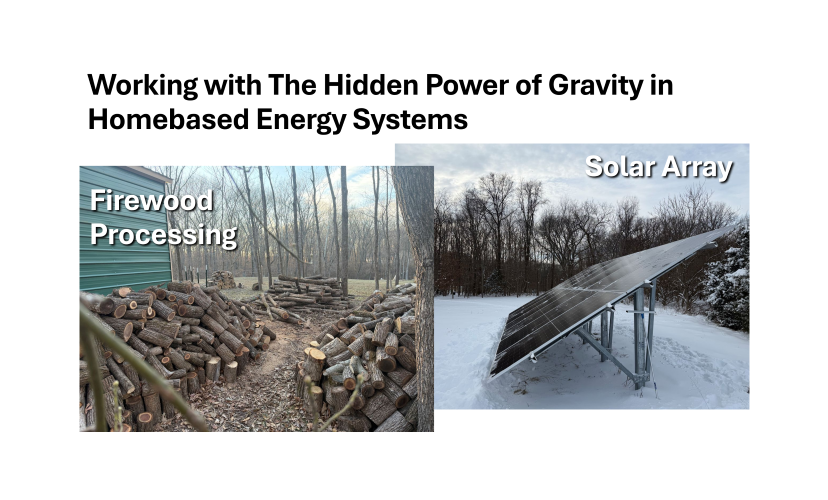
This winter, in Southern Illinois, we have received two, 10 inch snow storms (in November and January). A layer of snow on the solar panels produces zero power. We don’t get enough snow to merit an automated snow removal system. Most roof-top solar panels in our area simply wait 3-10 days for the snow to melt. I have better access to our ground-based solar array.
Solar panels are fragile and won’t withstand much friction or impact on their productive surfaces. Getting a few days extra power by removing snow at the cost of replacing a panel is a bad idea. I found a commercial foam squeegee that is lightweight and soft to safely and efficiently remove the snow from our panels. Last week, as the snowfall finished, I found that I could remove the snow from the lower, easy-to-reach end of the panel first. Snow sliding down glass did the job itself. The work was giving the snow column a nudge six or seven feet up the panel.
Once the lower snow was removed, I did the same from the top-end of the panel (10 feet off the ground). Because the lower half of the snow was already missing, all I needed to do was get the upper column moving and it also slid off the panel like ice on glass.
Running around in January tending to my solar array and our firewood supply (supplemental heat), gave me time to ponder the little things. Gravity fascinates me. We generally don’t even think about the role it plays because it is inherent in all our operations.
In my solar grid snow removal exercise, gravity with snow crystals (ice) on glass allowed the snow to remove itself after a nudge to get it started with my aluminum/foam squeegee. Before the lightweight squeegee, I used a wooden push broom. It was heavier and rougher than I liked on the high-valued solar panel surface, but it was easy to find and cheap. Lifting the wooden broom to the full extent of my reach took more calories than it takes to lift a much lighter foam squeegee. Again, gravity worked against the success of the heavier push broom. [Although lifting the broom allowed me to burn more calories (bioenergy)].
We worked through the spring and summer to accumulate seasoned firewood for our winter supplemental heat. A neighbor loaned us a log-splitter which was GREAT! We thought we would get back to splitting in the fall, but it didn’t happen. We have plenty of wood, but even the mechanically split wood is often larger than is handy to manage. I have spent most of January splitting wood. The kinetic, electric log splitter in my shopping cart has been unavailable, so I have used splitting wood as my cardo workout for an hour or two each day. It has been a great time to ponder physics.
I have an 8-pound maul (sledgehammer on one end, axe blade on the other). My favorite tool is my 3.5-pound, double bitted ax. I love throwing my not-so-dainty inertia into splitting wood. Most of my dry hardwood I can split with the ax. But some of the larger pieces require the larger, maul. Again, the power of the process of splitting firewood comes back to gravity. First, in cutting down the trees (gravity assisted). Then secondly, splitting the wood. This time the work on my end is lifting the ax or maul. Once it is above my head, my long arms and upper body strength assist gravity in slamming my sharp metal blade into the wood fibers.
In addition to marveling at the help I get from gravity, I burn off 800-1,000 calories of bioenergy during my wood splitting sessions. As long as I don’t cut myself with the ax, chopping wood is keeping me strong and healthy. The wood piles in the photo are next winter’s firewood inventory. I am looking forward to getting my electric, kinetic log splitter soon. In the longer days of summer, daily solar power generated surplus can split our firewood.
Home energy systems are not as automatic as utility-generated power. They take more time to manage. But like supplementing our food supply with our garden, or generating soil organic amendments from composting, it is good for mental therapy in addition to cost-savings. It is easier as an old man to invest the additional time than as a father of young children, or a young professional carving out a career. Part of the fun of making homebased energy systems work is in using ambient gravity to assist in powering our home.
Comments
The Unsung Role of Gravity in Residential Energy System Operation — No Comments
HTML tags allowed in your comment: <a href="" title=""> <abbr title=""> <acronym title=""> <b> <blockquote cite=""> <cite> <code> <del datetime=""> <em> <i> <q cite=""> <s> <strike> <strong>