
National Ag Day and the Role of Agribusiness in the Economy
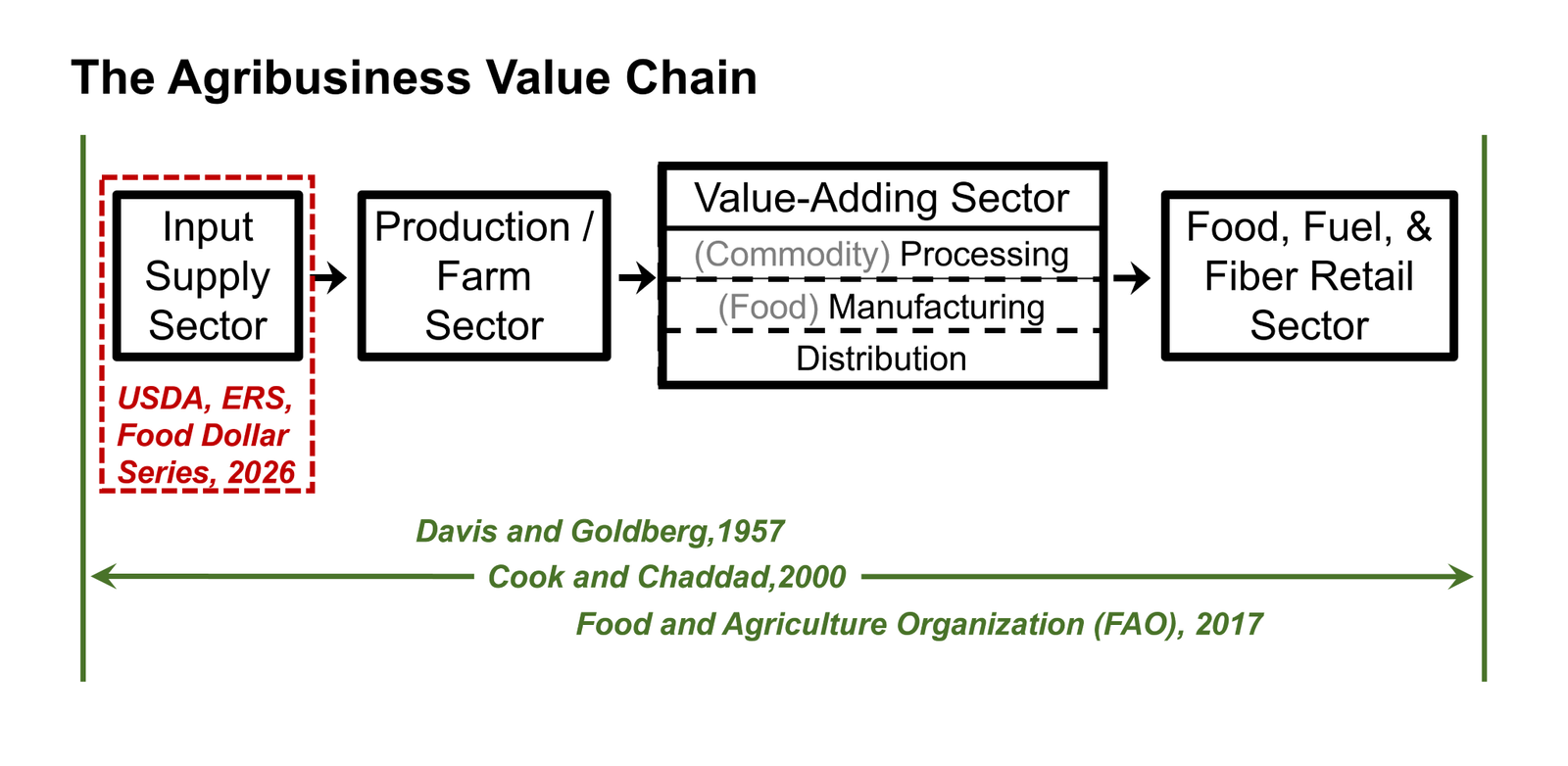
In celebration of National Ag Day, March 24, 2026, we are rallying from a winter of light blog posting, to recognize agribusiness’ role in the US economy. There is general consensus about the scope of the agribusiness industry, except within the very important Economic Research Service, Food Dollar Series. While the high value of this series is clear, it is curious that it restricts agribusiness to the very narrow farm input supply sector. This confounds the more common definition of agribusiness as the entire value chain.
In 2016, I was invited to build a 4-year agribusiness program at Greenville University in Illinois. That adventure had not been on my career bucket list, but I had spent over 3 decades working in and innovating up and down the agricultural supply chain. I also had 4, ag degrees in three different academic disciplines. I pivoted, late in my career into academic agribusiness. With limited resources at this small, private college, vocational agriculture instructions seemed daunting. Teaching these applied skills applied skills worked best with a significant investment in capital land, equipment, livestock and crop storage. But we could compete with large public agribusiness programs on the application of business management to agricultural businesses. That narrowed our 4-year undergraduate agribusiness program scope to something manageable.
The first challenge was defining agribusiness in a four-year degree program. A significant number of my previous posts in this space, look at many – often different – ways to define agribusiness. The challenge in defining agribusiness is due to a plethora of definitions, not from a lack of definition.
Historically, most of the definitions begin with the Davis and Goldberg, 1957, or a related definition.
“The sum of all operations involved in manufacture and distribution of farm supplies, production operations on the farm, and the storage, processing, and distribution of farm commodities”.
As the agribusiness industry has evolved others have documented this industry’s transformation. One seminal document on these changes is Cook and Chaddad, 2000, Agroindustrialization of the global agrifood economy: bridging development economics and agribusiness research. These first two sources are academic definitions. The industry itself as well as policy-making groups also influence the working understanding of agribusiness. A 2017, UN Food and Agriculture Organization (FAO) outreach publication, Agribusiness and value chains, states that the agribusiness sector, “covers the entire value chain, including the supply of agricultural inputs, the production and transformation of agricultural products, and their distribution to final consumers.” Agribusiness as a value chain is well documented.
Earlier in March 2026, the clarifying and thought-leading, USDA, ERS document, The Food Dollar Series, A More Detailed Food Dollar: Enhanced Accounting of US Food Costs, was updated and released. Recent documentation attributes this food marketing work as ongoing since 1946. This analysis has shaped generations, clarifying the value of farm production relative to food retail and food service. It has brought enormous value to our collective understanding of food economics.
The most recent release is no exception. In preparing this post, reviewing the documentation describing this comprehensive body of work is humbling. The US food system is extremely complex. Modeling and analyzing the economics of the US food system is also complex. As illustrated in the March 3, 2026 documentation, the numbers change if non-alcoholic beverages are included or not. Clearly, what is the value of a 32-ounce, fast food soft drink: economically, nutritionally, agriculturally? This food category also includes milk that has different nutritional and economic impacts than soft drinks. Alcoholic beverages are separate. It is complex. And USDA, ERS navigates this remarkably to bring everyone more clarity to the economics of food in the US.
Over the years, of US Food Dollar Series releases, documentation on the background for historically labeling of farm inputs as ‘agribusiness’ remains unclear. The USDA Food Dollar Series labels farm inputs as agribusiness. It is uncomfortable, even for a seasoned undergraduate agribusiness teacher, to stand before young adults embarking on potential careers in agribusiness, and show food dollar charts that indicate agribusiness has a smaller economic impact than farming. The easy fix is to identify the very narrow Food Dollar Series category, agribusiness, as a poor labeling choice. But to infer anything negative about the formative Food Dollar Series is also counterproductive.
In the big picture, this is not a problem. But confusing labels have hidden costs. It is not uncommon today in food, fuel, fiber, and environmental service economics to find practitioners that authentically consider agribusiness to be limited to input suppliers. The margins for success are too thin in the agricultural economy to have stakeholders bumping into each other by using different definitions.
There is far too much political and economic turmoil in our daily conversations in 2026. Gently poking the economic institutions as Biomass Rules is called to do, has been more difficult in our current environment. Still, the recent release of the USDA Food Dollar Series provides a venue to be both supportive and instructive. The current 2026 release moved away from the traditional production and farming label, instead describing it in units of crops, livestock, and forestry/fishing/agricultural services. Perhaps there is room in future Food Dollar Series Reports to shift the traditional agribusiness label in this series to one of ‘farm input supply?’
Agribusiness is an exciting and growing industry spanning not only the food industry, but also fuel, fiber, and environmental services. The continuous honing and refining of agribusiness definition and scope embodies both innovation and creative destruction. These are the same attributes that were recognized in the 2025 Nobel Peace Prize for economics to Joel Mokyr, Philippe Aghion, and Peter Howitt. Agribusiness is a very valuable, exciting, and ever-changing industry. It is important to keep adapting related terms to keep them most relevant.
Comments
National Ag Day and the Role of Agribusiness in the Economy — No Comments
HTML tags allowed in your comment: <a href="" title=""> <abbr title=""> <acronym title=""> <b> <blockquote cite=""> <cite> <code> <del datetime=""> <em> <i> <q cite=""> <s> <strike> <strong>