

Industry Terminology has a Powerful Policy Impact – Definitive Power


I had the unique privilege of being hired by the American Farm Bureau Federation in 1995 – straight out completing my PhD – because I had three graduate degrees in manure management. My other Farm Bureau responsibilities included eggs, poultry meat (poultry production contracts), public access to agricultural data, and my area of expertise, manure. I got to take advantage of endless vocation-related humor such as telling folks I had ‘manure on my name tag (because the word manure was literally on it).’
Becoming a national leader in manure use and policy had not been on my bucket list, …ever. But it was authentically an honor and privilege to land that frontier leadership role.
A revelation I had after several years in this role, was that even when a conversation is focused on the same issue or term, all the stakeholders applied their own definition based on their localized view. The lesson that became apparent to me – someone with graduate research in hog manure, broiler litter, and beef manure utilization – that there were a multitude of definitions in play. The more sensational definitions (manure destroying the earth), the greater the political influence. The practical, working definitions (fertilizer) had no political pizzazz. A dichotomy evolved. The three-part framework presented here expands it from simply a good vs. evil battle and allows the power of definitions to be leveraged or mitigated and facilitated the movement of political issues consistently forward.
Context on how manure became a national political football began in the 1990s. Several very large manure spills and livestock-related water quality issues hit the national news. I was hired in part because there was an awareness that new stricter EPA regulations on farm application of manure were on the way. A brief history of that turn of the century manure regulatory saga is summarized in the February 2025 post, Discovering Manure Value When Markets and CAFO Regulations Both Fail.
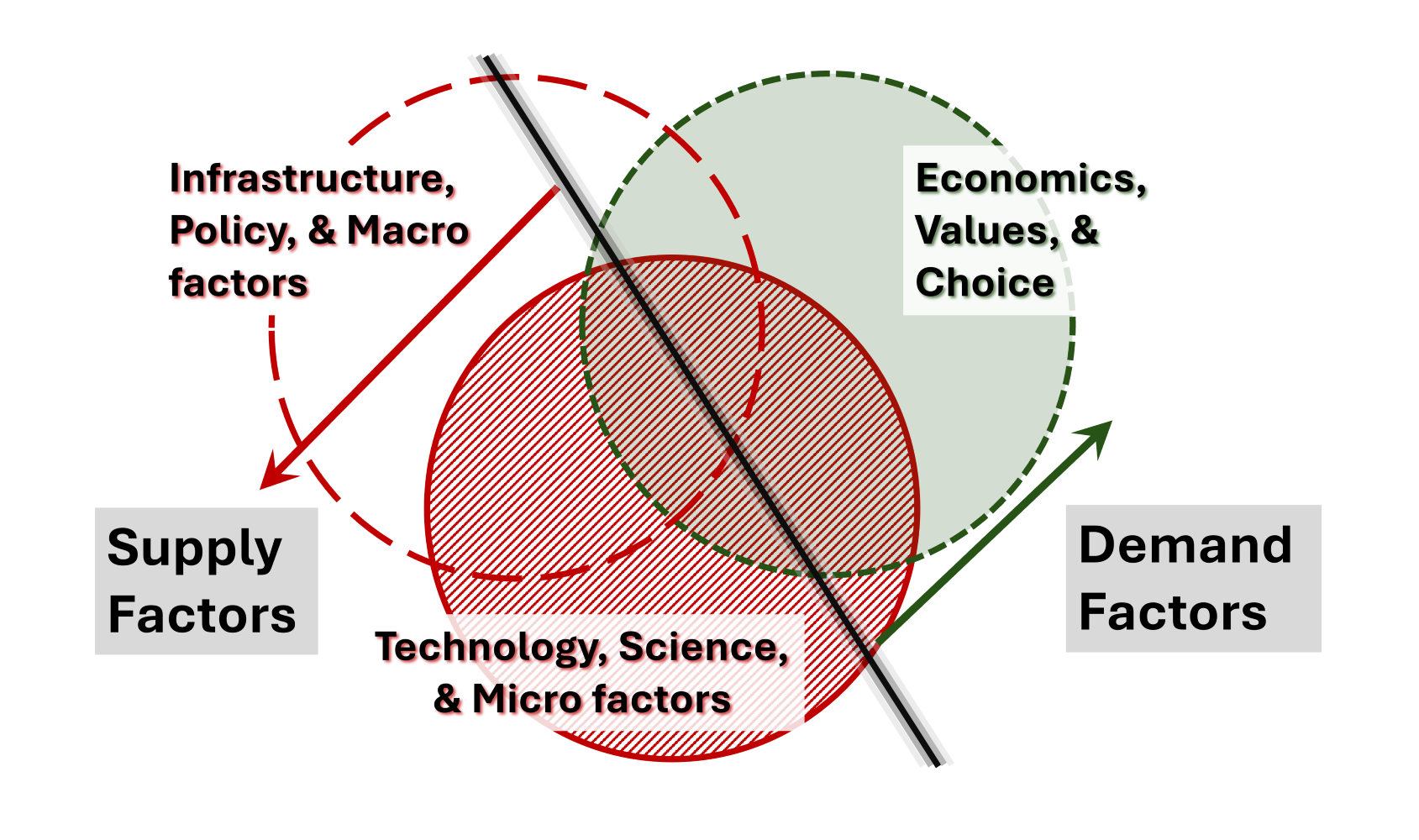
Differing Views from Supply and Demand (solid diagonal line). A fundamental challenge was not that there was no definition of manure. It was that there were many, many definitions of manure. The differences were based on the perspective of the user. Consumers defined manure differently than manure producers. One easy break in this simple taxonomy was in whether the issue was based on supply (producers) or demand (consumers).
- Manure resource vs. liability. Producers see manure as fertilizer and organic soil amendments, while consumers historically have viewed manure as smelly and an environmental liability. For more details check out the June 2024 post, Manure is NOT a 4-Letter Word.
- Natural gas vs. methane. Natural gas producers view the fuel they produce as natural gas, while consumers view natural gas unexpectedly in the atmosphere as methane. In this case the chemical that carries the energy in natural gas is methane. But culturally, if it is where we expect it in natural gas fuel, it is natural gas. When it is not the conventional fossil fuel, it dawns the politically heavy label of methane.
- Processing vs. treatment technologies. Entrepreneurs and business developers look at technology as processing technologies. Wastewater treatment managers protecting consumer safety, look at the same technology as at treatment technology.
There are other resources in the Biomass Rules ecosystem. For more on this checkout 1) Definitive Power: The Policy Impact of Definitions, or 2) Ruling Blind: Regulation without Information. Both of these documents were forged in the crucible of navigating manure regulations where participants were all talking about manure, but few were actually talking about the same thing.
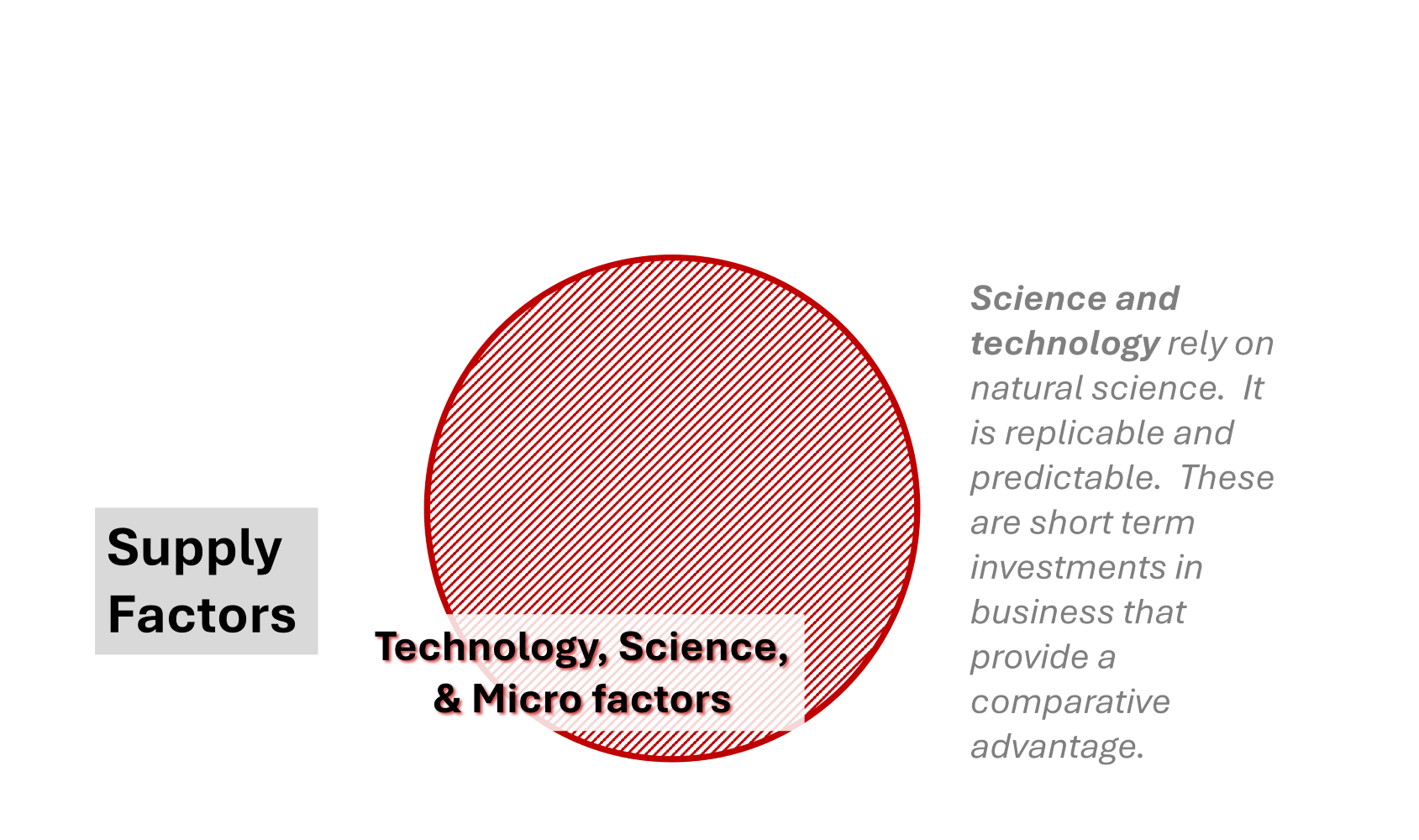
Differing Views from Short-term and Long-run Supply (circles within the Supply side). Even on the supply-side the applications of these terms can be broken down into microeconomic (short-term) and macroeconomic (long-term) definitions. Admittedly, this is not a very conventional definition of micro and macroeconomics. The short-term supply factors include the laws of science and technology. Most business decisions fall into this container.
The laws and policies become market overhead with long-run impacts. As outlined in the earlier post, Discovering Manure Value When Markets and CAFO Regulations Both Fail, the new manure regulations of the 2000s never did become active law. The eventual balancing of the 1990s manure environmental problems resulted in market-driven solutions that were more efficient than any of the proposed EPA regulations. The difficult part of this story is the market-driven solutions were prioritized to get fixed because the threat of very restrictive regulations was a serious economic challenge. The initial environmental liabilities from livestock farms were a case where both the market and government failures had created authentic externalities. It also took both market and government solutions to bring those externalities back into check.
But the point of this post is that issues – and the words that describe the issues – take on different definitions depending on the context of the conversation being held. As illustrated in this narrative, ideas like manure take on different meanings for consumer demand, long-run policy and market infrastructure, and science and technology applications.
When all stakeholders are literally talking about the same issue or term, but using differing underlying definitions, progress will be more circular than forward.
Measurable forward progress requires an acknowledgement of all the stakeholder positions followed by general agreement on how to preserve the prior values while moving to higher ground with new solutions.
Comments
Industry Terminology has a Powerful Policy Impact – Definitive Power — No Comments
HTML tags allowed in your comment: <a href="" title=""> <abbr title=""> <acronym title=""> <b> <blockquote cite=""> <cite> <code> <del datetime=""> <em> <i> <q cite=""> <s> <strike> <strong>