
St. Louis Agribusiness Club Reflects on the Power of the Mississippi River
The St. Louis Agribusiness Club is a tremendous St. Louis area agricultural network. Ten years ago, when a local Greenville leader told me that my future success relied on getting to St. Louis Agribusiness Club meetings. I did not hesitate. Every month, I connect with the movers and shakers in the local agricultural infrastructure. The benefits far outweigh the costs.
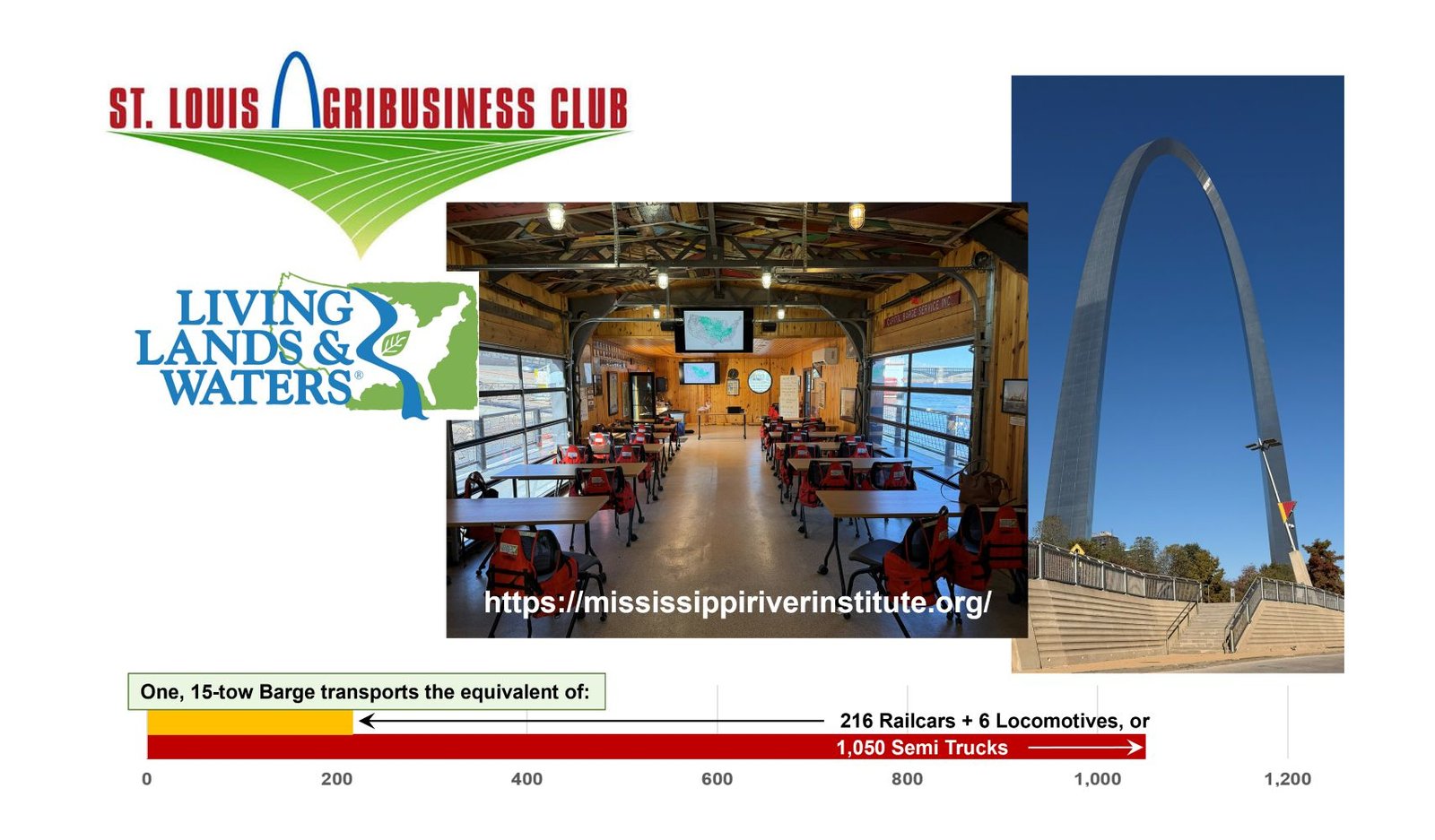
This week (11/16/26), the St. Louis Agribusiness Club met on the Mississippi River, just below the St. Louis Arch. It was a great place to be, meeting on a classroom barge on the Mississippi River! The barge was the Mississippi Institute classroom. The parent organization is the Living Land and Water. Rooted in protecting and preserving the river resources, the Mississippi Institute classroom has a high priority on workforce development for river industries. Because the classroom is a barge, it moves. It has been docked on the St. Louis Riverfront since July 2026 but will soon relocate in Tennessee for the beginning of the 2027 calendar year. The primary focus is high school juniors and seniors thinking about their path beyond high school. They also provide meeting space for companies and organizations.
In addition to the Institute’s manager and educator, Rachel Loomis, the Club also heard from Jack Gallwas, with Continental Grain and Barge and Ryan Missey, with Bunge. Both of these river industry representatives brought valuable context to the vital connection the Mississippi River provides for all commerce, but particularly agricultural product movement through the St. Louis Gateway to the world.
It was mostly a reminder of the information most of us knew, but don’t keep foremost in our thoughts each day. It is why we all work in agribusiness in St. Louis. It is a global hub.
There are many great river industry and ecological resources available. Too many to include in this post. But it was mentioned one of the benefits for St. Louis is that it curates both a vibrant trucking hub as well as rail and barge hubs. The size of a 15-barge unit is remarkable. Arranged typically 3 barges wide by 5 barges deep, these transports carry the equivalent freight of 1,050 semi-trucks or 216 rail cars being pulled by 6 locomotives. While these numbers are provided in many forms, Biomass Rules go-to site for this data is the Iowa Department of Transportation.
St. Louis Agribusiness Club brings the leaders on the agricultural frontier together each month and makes all the leaders in these industries better in the process. I attend a lot of meetings for many reasons. But the Agribusiness Club programs and meeting sites are always compelling and I get to compare notes with the industry, educational, and policy leadership each meeting. The Club’s leadership and Board are brilliant young leaders, but have benefitted personally from the leadership of the Club’s Executive Director, Dean Dittmar.
St. Louis is setting the curve in agribusiness. Glad I could make it to the Mississippi Institute’s classroom barge this week to be reminded of that happy fact.
Comments
St. Louis Agribusiness Club Reflects on the Power of the Mississippi River — No Comments
HTML tags allowed in your comment: <a href="" title=""> <abbr title=""> <acronym title=""> <b> <blockquote cite=""> <cite> <code> <del datetime=""> <em> <i> <q cite=""> <s> <strike> <strong>