
Buying a Farm with the Sweat of One’s Brow is an American Dream
It is also a slow way to build capital.
While I was in high school, I remember one of our farm neighbors, built a commercial hog farm largely on his spirit and work ethic. Several large farmers helped cover his startup costs. It was motivation for me that I could make it also. Before I got into commercial hog production myself, this inspirational farmer had lost everything. That was also a valuable lesson.
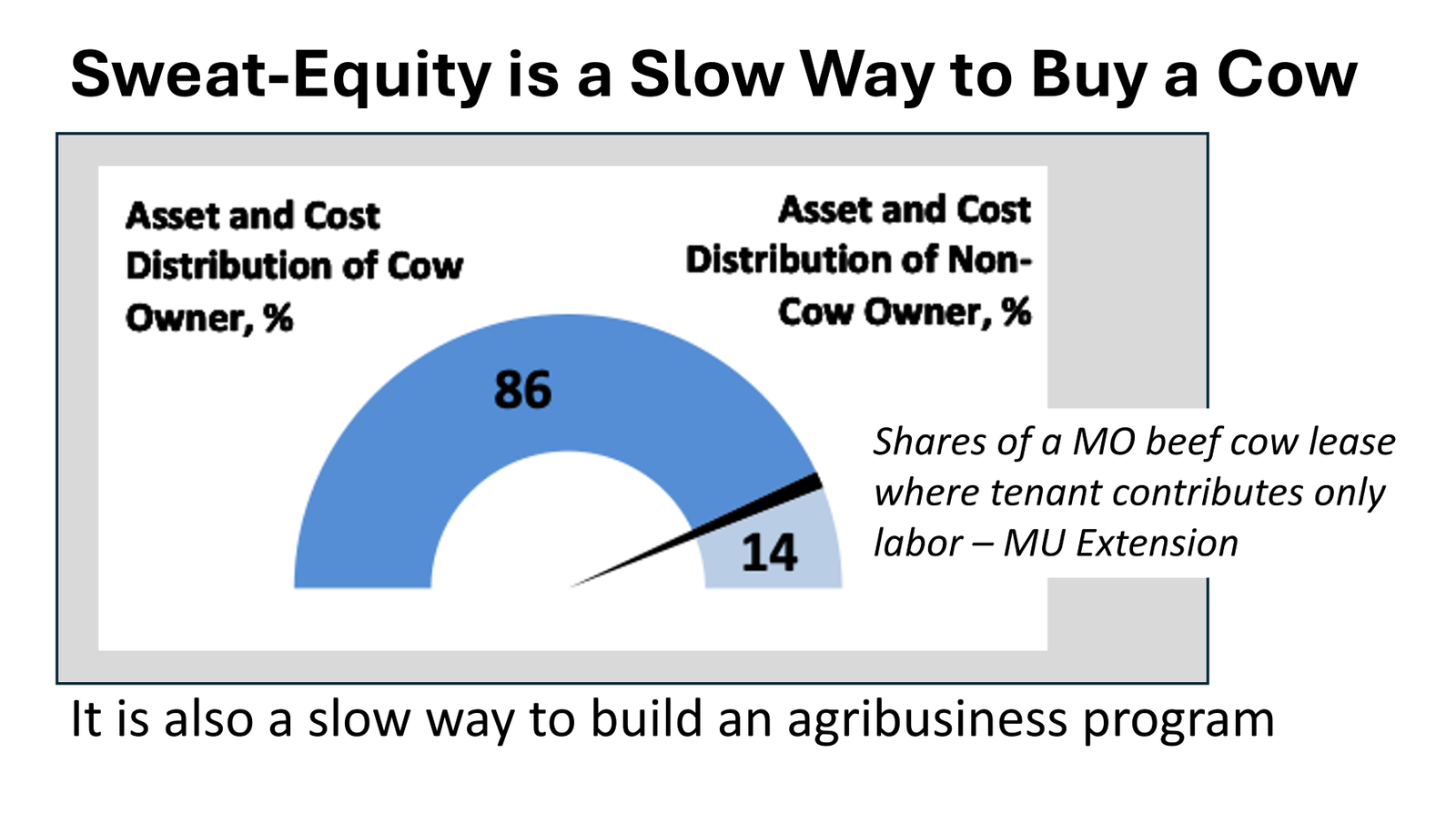
This chart was developed while I was working in a cow-calf production area of Missouri. A well-established beef producer came into our Extension office for advice on bringing is adult daughter back into their beef operation. The farm parents were going to sell the cow herd to their daughter and her husband on a share basis. “Sell” is likely debatable, but it works here to explain the transfer of asset value.
His question was straight forward enough. “Is a 30-percent ownership share the right number?” Still, I didn’t understand it. For him it was a yes or no question. I asked more questions for clarification.
- Who is paying for what?
- Are the cattle owners doing labor?
- Are the cattle owners sharing the variable costs?
I pulled up University budgets and spreadsheets, and the farmer went away bewildered.
I resolved to serve my farmers better. I built a decision aid (in a spreadsheet) with slider bars and a ‘calculate’ button. The farmer and I were both correct. His question was one of validation, not discovery. A 30 percent, owner-tenant share of a cow, is both common and a safe risk.
My very broad background in business development and local unfamiliarity with cow leasing practices created too many variables for me to provide a yes or no answer. The decision aiding spreadsheet, however, provided a bridge to showing cow/calf producers why it matters in a very rapid manner.
- When the cow owner owns the cow (and bull) and pays all the costs while the cow tenant only provides labor, the ownership share is 86 percent for the owner and 14 percent for the tenant. [If the cow owner puts in half the labor, the tenant share drops to 9 percent.]
- When the cow owner owns the cow (and bull), pays half the variable costs and provides no labor, the ownership cost is 70 percent for the owner, and 30 percent for the tenant. [When the owner shares half the labor the share shifts to 75/25 percent].
- When the tenant buys into the herd at a 30 percent ownership level, sharing cow and breeding costs, and shares 30 percent of the variable costs, and also provides 30 percent of the labor; the ownership share is also 70 percent for the cow owner and 30 percent for the tenant.
- When the tenant does everything in option 3, but provides 100 percent of the labor, the ownership shares shift to 60 percent share of the cow owners and 40 percent ownership share for the tenant.
In my mind the components make a difference.
The idea of leasing a cow (breeding stock) seemed unusual to me, not growing up in a cow-calf production area. But when I got into commercial hog production, my uncle leased me 100 of his sows (bred females). The terms were that he received a 40-lb feeder pig out of each litter and I cared (fed) for his momma pigs for the next 6 months. It was brilliant. I received new breeding females from the crop of pigs. My uncle got paid for the sale of 100 feeder pigs, his breeding females (sows) gained weight, and a bonus was the price for slaughter sows was higher when they were sold than when they were bred for my benefit.
Purchasing assets is costly. There are many variations of paying for the asset (fixed costs) and the costs of maintaining the asset (variable costs). In addition, there is always volatility in the input and output markets that must be covered also.
A bird in the hand is worth two in the bush. Or owning an asset today is more valuable than owning double the asset in the future (yet to be obtained). Cash has a premium.
There are lots of ways to pay for an asset, but there is no such thing as an easy way to pay for an asset. There are always costs, some methods cost more than others.
This slide was used to illustrate the sweat-equity method of building an agribusiness program at Greenville University. Most of the students I taught each semester were business majors other than agribusiness majors. This allowed us to use my career in agribusiness development to teach a smaller number of students agribusiness. In this case, it was a very valid way to fund the new program.
Purchasing farm assets through hard work is a way, but it takes a long time to buy a cow if it is only paid for in labor. Working hard is a slow way to purchase assets in general. It should not be overlooked. Ownership over time accumulates equity in business. It generally takes more than hard work to be successful.
Comments
Buying a Farm with the Sweat of One’s Brow is an American Dream — No Comments
HTML tags allowed in your comment: <a href="" title=""> <abbr title=""> <acronym title=""> <b> <blockquote cite=""> <cite> <code> <del datetime=""> <em> <i> <q cite=""> <s> <strike> <strong>