
Planning Pays – Extension Provides the Tools for Hungry Entrepreneurs
This document is a workbook, rather than a textbook. It is written for individuals to build their planning toolbox, rather than provide a check list for a class project. It is also written for lay people. Adults looking for a summary of things to think about may be frustrated by this format.
But if a budding entrepreneur’s goal is to run a successful business, set that frustration aside. Shortcuts come with a cost. If the enterprise that is being considered is a first-time venture, there is no substitute for processing all the steps.
I used this in my college, agribusiness classes and observed regular ‘eyerolling’ from my students. My goal was to introduce them to this resource in class, so when they were actually starting their own business venture, they might recall that there are resources.
Similarly, as a professional business planner, conducting feasibility studies for entrepreneurs, most of them were told they needed a feasibility study. In many of their minds they simply wanted to know if their ‘great idea’ would cash flow. But as a planner, the fun was watching all the pieces fit together, …or not. One of the best parts of planning is finding out where the gaps are.
It is vastly less costly to find and fix the gaps in the material and cash flows ‘on paper’ than to become aware of gaps during the buildout and operations. Those unplanned surprises will still happen, but planning minimizes the frequency and expense of discovering them after construction has begun.
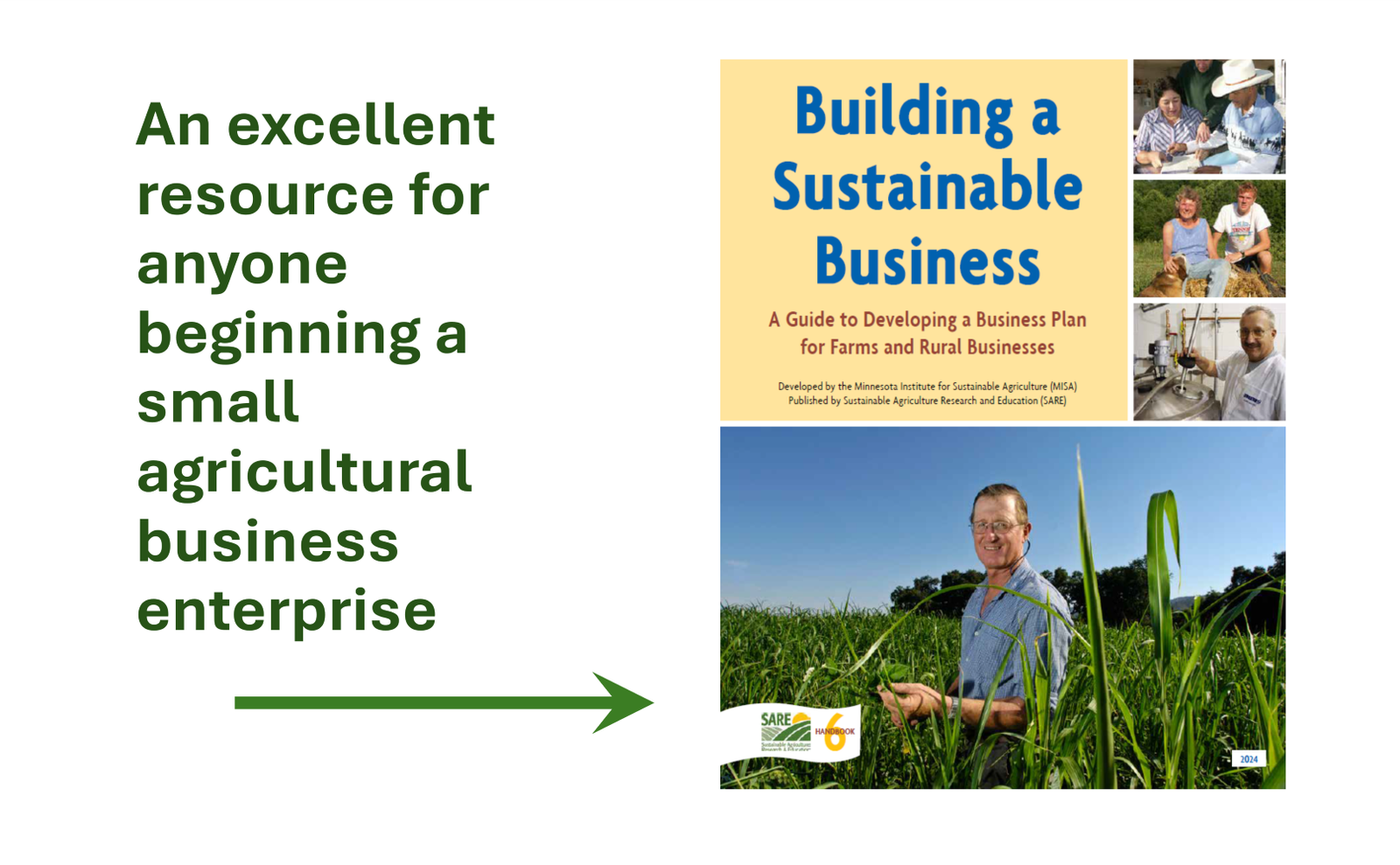
Building a Sustainable Business sections include:
Identifying Values
Farm History and Current Situation
- Marketing Situation
- Operations Situation
- Human Resources Situation
- Financial Situation
Vision, Mission, and Goals
Strategic Planning and Evaluation
- Market Strategy
- Operations Strategy
- Human Resources Strategy
- Financial Strategy
Implement and Monitor your Business Plan
The workbook comes with lots of worksheets and examples.
One of the great revelations that I had during my career as an Extension Specialist with the University of Missouri is just how readable Extension publications are. They are created for working people, not academics. But they are very technical material written in easy-to-understand terms.
Extension publications should be part of every introductory course in undergraduate agricultural programs. I saw some as I went through my degrees, but there is room for more of these open assess materials in the classroom. There is a place for academic jargon in professional pathways. Graduates need to know the industry and academic terminology. But for introduction of very technical ideas to students new to the field, Extension publications can be an excellent first step.
While this Building a Sustainable Business publication is published by SARE, it was developed by the Minnesota Institute for Sustainable Agriculture (MISA). I consider it a unique privilege to have worked with recently retired Director, Helene Murray, when we were younger in the Peace Corps in Nepal. Over the course of our careers, knowing Helene was providing leadership in sustainable agriculture has provided great confidence that our future is secure. Or, at least as secure as sustainability is sometimes viewed, writing as a professional manure visionary myself. But MISA set the bar and assured that tools were available to farmers in Minnesota and beyond.
Comments
Planning Pays – Extension Provides the Tools for Hungry Entrepreneurs — No Comments
HTML tags allowed in your comment: <a href="" title=""> <abbr title=""> <acronym title=""> <b> <blockquote cite=""> <cite> <code> <del datetime=""> <em> <i> <q cite=""> <s> <strike> <strong>