

Which Sector Leads Agricultural Workforce Development?
Is it the 4-year, higher education, secondary education, or the rapidly changing agricultural industries? In a perfect world all these groups would complement each other. They do work together, actually, but under the surface there is competition for that leadership role, with each group building a comparative advantage upon why they should provide the workforce leadership guidance.
One of the ideal crucibles for all of these workforce development stakeholders to come together is the St. Louis Agribusiness Club. Last month, in April, the Club met at Southern Illinois University in Edwardsville (SIU-E). Tours were available at the National Corn to Ethanol Research Center, an innovation hub commercializing ethanol technology development. The Club membership is largely industry members but also include many policy and education stakeholders. The main program at the April meeting was presentations from the Deans of SIU-Carbondale, University of Illinois-Champaign, and University of Missouri-Columbia (The last two universities are statewide, but the Deans work out of Champaign and Columbia).
All three Deans addressed workforce development and provided solid evidence of their success. Academic success is a complex attribute. For example, Michael J. Sandel in The Tyranny of Merit: Can We Find The Common Good, explores the incentives for higher education institutions and their faculty. It identifies reasons why merit, doing great work, has become a less efficient metric for academic success than intended.
In conversations with ag economic peers about the role of undergraduate agribusiness programs in their institutions, it became clear that success of undergraduate degree programs is motivated by different factors at land grant, regional state, and private institutions. The agribusiness program developed at Greenville University was intended to prepare undergraduate students to enter the workforce prepared to excel in private companies, or ready to work. Other larger public institutions with large research programs relied on their undergraduate programs to provide the most prepared individuals to lead innovation in future graduate programs, or in their professional development. This is more than preparing undergraduates to be ready to work.
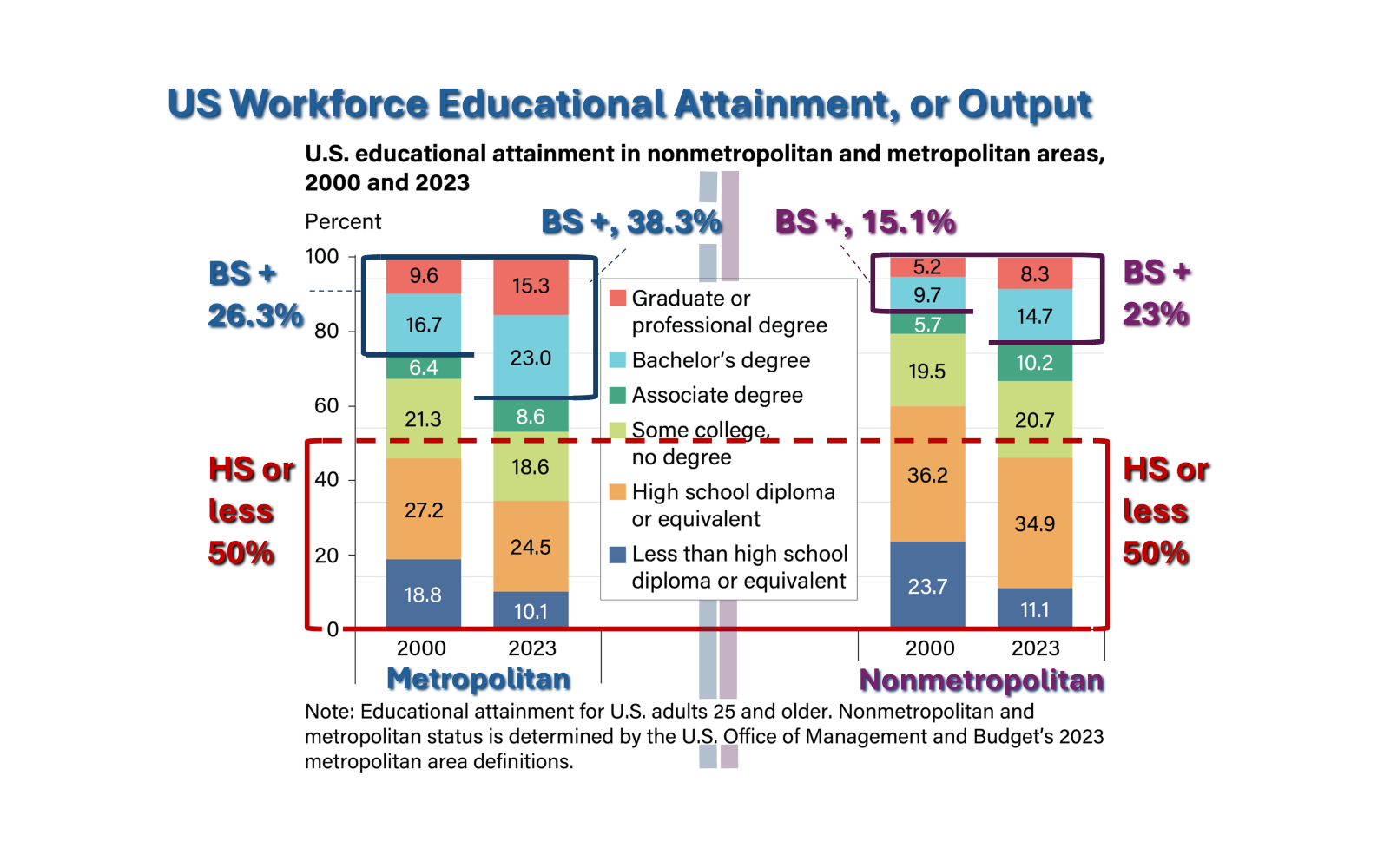
In Illinois, where Greenville University is located, agricultural education leadership is provided by the community college and high school vocational agriculture programs. As evidenced by the USDA, Economic Research Service, (ERS) chart on Educational Attainment, most adults, 25 years or older do not have a bachelors degree (BS) or higher. For agricultural education programs in Illinois from kindergarten through associates degrees at community colleges (k-14), curriculum leadership is provided by educators that are certified to teach agriculture.
With approximately 75 percent of adults not pursuing a degree above an associates degree, the high schools and community colleges carry the largest burden of training up agricultural workers in the workforce.
So, are the 4-year, large public institutions in the best position to lead workforce development?
Adding industry stakeholders who hire workers so that they can be the most efficient and successful also play a role. As technologies are commercialized, educational infrastructure lags behind technical innovation. Generally, industry and public funding are used to equip educational institutions to deliver the most prepared and relevant workforce. Sometimes the industry and non-profit associations move to innovate more rapidly without the educational institutions. This is generally a short-sighted notion. Industries know what they need for workers, but the education infrastructure knows best at preparing those workers.
One of the workforce development stakeholders that facilitate the industry and education industries is the public policy sector that provide funding, regulation, and incentives for both industry and education.
There are many moving parts in the development of the US agricultural workforce. Everyone has their specialized, comparative advantage. This infrastructure is most efficient when they are able to move together.
On a slightly different theme, this chart also illustrates the metropolitan areas (urban centers) had changing demographics than the nonmetropolitan areas (rural). In the last two decades, higher education in the nonmetropolitan areas has increased to nearly the levels that occurred in the metropolitan areas at the turn of the century. During that time, higher education has increased to nearly one third of the urban workforce (38 percent).
As technology advances with digital and through life sciences, changes are being driven more rapidly. Ten years ago, the Federal Aviation Administration (FAA) had not completed their regulations for agricultural drone use. This made it difficult to legally innovate in business, as well as develop workforce readiness in the educational intuitions. Two years ago, academic institutions were banning the use of Artificial Intelligence (AI) in their classrooms. Today, if institutions are not teaching students to use AI they are falling behind the norm.
Coordinating workforce development across higher education, secondary education, industry, and public policy is moving fast enough that this is still an emerging consideration. Resources are strained and trends are constantly adjusting.
Leading the workforce development infrastructure changes is vital to our future success. It is exciting to be an active participant through our regional agribusiness coordinating body, the St. Louis Agribusiness Club. Great work everyone!
Comments
Which Sector Leads Agricultural Workforce Development? — No Comments
HTML tags allowed in your comment: <a href="" title=""> <abbr title=""> <acronym title=""> <b> <blockquote cite=""> <cite> <code> <del datetime=""> <em> <i> <q cite=""> <s> <strike> <strong>