
Composting Adds Value Regardless of the Economic Chaos Flavor of the Day
With great confidence, all organics are going to rot. There is a gratifying consistency in this certainty. The global and US farm economies are on fire with wars and rumors of wars. It is a difficult season to be a farmer in the US. But long run success is more certain in the long run for both composting and an economy.
Even so, spring’s arrival is right on schedule. Woods and fields and residences are bursting with the new life of spring in the upper Midwest. New green plant growth is feeding off the rotting organics from last fall, or from an even earlier season. As nature bursts forth with life in April, the winter’s Biomass Rules composting project gets spread to the nutrient-poor soils on our property. It is a slow but steady process. Time tested, composting is a blend of science and art.
Composting organic residuals is a management choice. It is a living technology used at our facilities because our ancient clay soils are low in nutrients and water holding capacity. Adding organic matter improves soil productivity. It is a long run game.
Biomass compost feedstocks are provided mostly by invasive species. Ripping out these invasives provides both physical and emotional therapy. As visible in the background of this image, there are ample supplies of future compost feedstocks (honeysuckle and multifloral roses still on the stump).
Throwing these extracted plant carcasses and brush in my compost pile converts the unwanted growth into a beneficial soil amendment. Other feedstocks for the ever-active composting pile are cardboard, junk mail, table scraps, and discarded cotton clothing.
Composting takes time. There are many ways to manage compost, just like there are many ways to manage any farm or business. Some stabilize the rotting carbon rapidly. Others work more slowly. The objective function of the Biomass Rules composting operation is to absorb maximum organics producing as many benefits as possible (exercise, emotional therapy, and enhanced soils). Time is an input. Finished compost is spread twice a year.
Many logs, branches and other woody fibers do not degrade completely in 6 months. The woody biomass gets pulled from each finished pile and added to the next formative pile. Time and the certainty of decomposition reduce tree branches to soil. Moving the piles routinely and encouraging preliminary biological degradation serves as an alternative to relying on a traditional chipper.
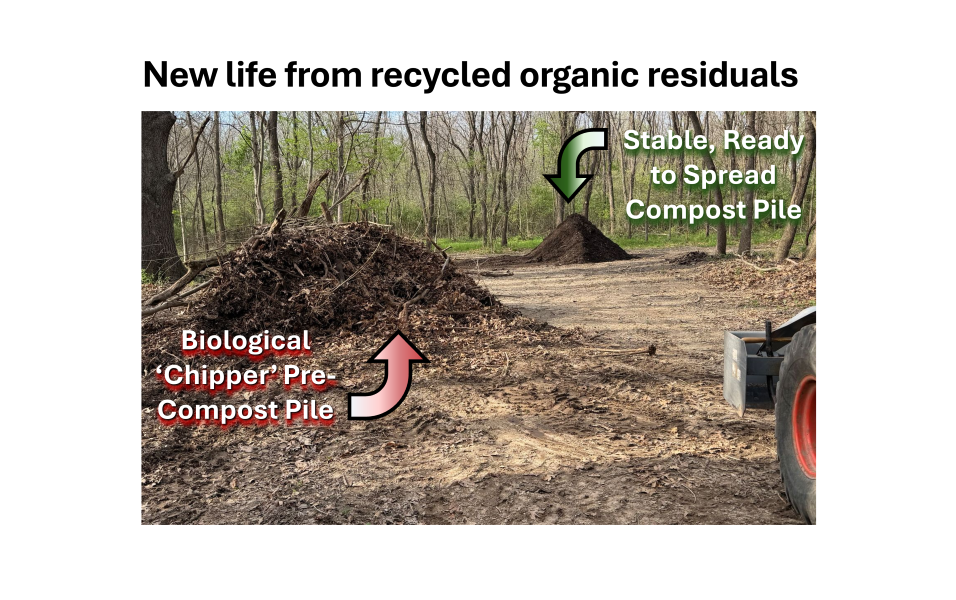
In this blog image, the closer pile on the right is my ‘biological’ chipper, pre-composting pile. It is moving across the pad toward the finished compost pile behind and on the right. It moves about 15 feet a week. By the time the right-hand pile has reached the left-hand pile site, the left-hand pile will have been applied to the ancient clay soils on the property.
Management matters. This work is not to commercial grade compost standards, but it is managed well. My 45-year career has centered around managing soil organic amendments as a nutrient and soil structure management technology. Organic nutrients and biologicals have been growing in popularity in crop and livestock production. As commercial fertilizer prices remain high, producers should be sure to manage their soil organic buffers. Twenty years ago, it was not uncommon for farmers to apply manure nutrients to their crops and then also apply commercial fertilizers at the recommended rates. Times have changed and it is not uncommon for organic nutrients to provide a crop’s primary source of nutrients.
In addition to building soil organic buffers with waste biomass feedstocks, my professional work has been to make new innovative ideas add value to the economy. This requires management-driven, site-specific choices. Most farms and businesses succeed with well-developed value chains and linear technologies. But when things are not well-defined, local solutions can provide both comparative and competitive advantages. Successful producers manage both traditional and alternative solutions, especially in difficult economic times.
Even though I am not directly growing food, I still find joy in folding unused organic residuals and enhancing soil organic buffers with compost. Looking to the long run, composting provides a high certainty of success. Economic success in these difficult times also looks brighter in the long run.
Comments
Composting Adds Value Regardless of the Economic Chaos Flavor of the Day — No Comments
HTML tags allowed in your comment: <a href="" title=""> <abbr title=""> <acronym title=""> <b> <blockquote cite=""> <cite> <code> <del datetime=""> <em> <i> <q cite=""> <s> <strike> <strong>